
Ecommerce SEO Services That Turn Organic Traffic Into Revenue
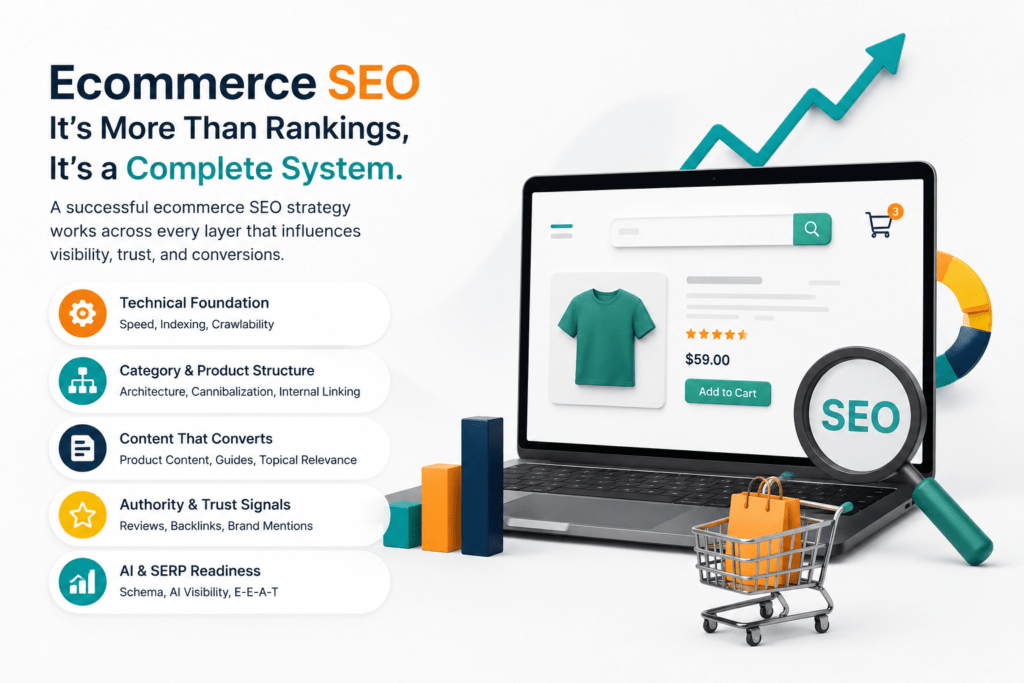
Ecommerce SEO Services aren’t about stuffing keywords into product descriptions. They’re a connected system — technical foundation, product and category architecture, content, authority, and increasingly, AI search visibility — built to turn organic search into qualified buyers and sustainable revenue.
I’m Tanveer Evan Rahat, founder of NexaForge IT. I work with Shopify, WooCommerce, Amazon, and custom ecommerce platforms across Bangladesh, the UK, USA, Canada, Australia, and Europe — on our technical SEO foundation first. This page explains the full framework behind that work.
Tanveer Evan Rahat · Ecommerce SEO Consultant · AI-Driven SEO Consultant
ECOMMERCE SEO GROWTH SYSTEM
Explore Our Ecommerce SEO Services
Ecommerce SEO
The hub engagement — technical, product, category, content and authority run as one system.
Amazon Store SEO
Listing optimization and keyword targeting inside Amazon’s own search engine.
Shopify SEO
Theme speed, collection architecture and app-bloat crawl waste, handled at the source.
WooCommerce SEO
WordPress technical debt, taxonomy sprawl and product schema for Woo stores.
What Ecommerce SEO Services Actually Involve?
The layers aren’t optional add-ons — they’re one system, which is why I run them as a single engagement rather than piecemeal fixes.
Most stores treat ecommerce SEO as product-page keyword tweaks. That’s a fraction of it. A complete ecommerce SEO services engagement moves through technical foundation, category and product architecture, internal linking, structured data, content, authority, and AI search readiness — each layer feeding the next.
A store with excellent product copy but broken faceted navigation still loses organic visibility. A technically flawless site with thin category pages still underperforms on commercial terms. That sequencing sits at the centre of my core SEO framework.
Amazon Store SEO
For sellers competing inside Amazon’s own search engine — Amazon SEO focused on listing optimization, keyword targeting, category relevance, and conversion-focused product content that moves you up Amazon’s own rankings, not just Google’s.
Shopify SEO
Shopify SEO services built around Shopify’s specific technical structure — theme-level speed issues, collection architecture, app-bloat crawl waste, and the internal linking patterns that make Shopify stores genuinely rankable, not just pretty.
WooCommerce SEO
WooCommerce SEO services addressing WordPress-specific technical debt — plugin conflicts, taxonomy sprawl, category cannibalization — alongside product schema and site performance work WooCommerce stores consistently need.
Not sure which applies to your store?
The Ecommerce SEO Framework
Crawl, index and render access before anything else.
Commercial and informational demand, mapped to the catalog.
Architecture built around real commercial search demand.
Titles, descriptions, schema and images tied to intent.
Discovery paths for both buyers and crawlers.
Guides and comparisons that feed category and product pages.
Structured product data and consistent entity information.
Relevant links, brand mentions and the trust layer.
Eligibility to be understood and surfaced by AI systems.
Content built without intent mapping attracts browsers, not buyers.
🎯The framework is consistent across markets — see the international SEO framework
Why Ecommerce Stores Lose Organic Visibility?
Catalog vs. traffic gap
Thousands of products, almost no organic traffic to show for it
Keyword cannibalization
Product pages quietly competing against each other for the same terms
Thin & duplicate pages
Duplicate or thin product and category pages
Faceted navigation
Generating thousands of crawlable, worthless URL variants
Indexation failure
Products that simply never get indexed
Weak internal linking
Little connection between related products and categories
Missing schema
No Product, Organization, or Review markup
Poor CTR
High impressions, low clicks — visible but not compelling
Non-converting rankings
Rankings that don’t convert
Paid traffic dependency
Heavy, growing dependence on paid ads to cover organic’s gap
Weak AI search visibility
Little to no visibility in AI-generated search answers
What's Included Across Every Engagement?
Technical Ecommerce SEO
Crawlability, indexation control, canonical URLs, Core Web Vitals, JavaScript rendering issues, faceted navigation cleanup, XML sitemaps, and robots.txt configuration — the access layer everything else depends on.
- Crawlability
- Indexation
- Canonicals
- Core Web Vitals
- Sitemaps
- robots.txt
Reference basis: Google Search Central’s technical SEO and Core Web Vitals guidance.
Product SEO
Product titles and descriptions mapped to real search intent, not just keyword insertion. Product schema, image optimization and alt text, review integration, and internal links that connect related products intelligently.
- Product schema
- Image alt text
- Reviews
- Related products
Reference basis: Schema.org Product/Offer/Review markup and Google Merchant Center product data requirements.
Category & Collection SEO
Category architecture built around commercial search demand, collection page content that isn’t thin filler, breadcrumb structure, and internal linking that helps both users and crawlers discover products efficiently.
- Commercial demand
- Breadcrumbs
- Collection content
- Discovery paths
Ecommerce Content Strategy
Buying guides, product comparisons, and informational content that serves top-of-funnel search intent — then links strategically into category and product pages to pass that traffic toward conversion.
- Buying guides
- Comparisons
- Top-of-funnel
- Conversion paths
Authority & E-E-A-T
Relevant backlinks, digital PR, brand mentions, and entity signals that build the trust layer Google — and increasingly AI systems — use to decide whether your store is a credible source.
- Digital PR
- Brand mentions
- Entity signals
- Trust layer
Reference basis: Google’s Search Quality Evaluator Guidelines on E-E-A-T.
Ecommerce SEO Health Benchmark
01
Indexation
02
Product URLs
03
Category Pages
04
Internal Links
05
Product Schema
06
Core Web Vitals
07
Faceted Navigation
08
Content
09
Entity Signals
10
AI Search
Ecommerce SEO for Global Markets
Ecommerce search behavior shifts by country, language, currency, and platform. An international ecommerce SEO approach accounts for regional search intent, hreflang implementation where multiple markets are served from one domain, country-specific landing pages, and the duplicate-content risks that come with running near-identical product catalogs across markets.
The framework doesn’t change by market. The keyword research, currency considerations, and regional intent mapping do — the same principle behind our international SEO framework.
Markets served
Illustrative diagram of markets covered — not traffic or client data.
Ecommerce SEO Experience Across Global Markets
My ecommerce SEO work and research span multiple markets, with strategies adapted to the platform, catalog structure, commercial intent, and search landscape of each market.
Bangladesh
Client ProjectRFL Eshop is one example of ecommerce search work in the Bangladeshi market, where the focus extended beyond individual product keywords into broader topical authority and organic search visibility.
The wider Bangladesh ecommerce market also includes established platforms such as Othoba, whose positioning around online shopping and broad product availability reflects the competitive nature of commercial search in this market.
View Ecommerce Case Study →Canada
Market BenchmarkThe Canadian ecommerce market has its own search characteristics, particularly around product availability, local purchasing intent, wholesale searches, and category-level competition.
For example, OnlineOrganics operates across Canada with a large catalog covering organic grains, flour, rice, sugar, snacks, beverages, and other bulk products. Its site structure includes dedicated product collections, Canadian product categories, wholesale purchasing information, and individual product pages.
This type of ecommerce environment demonstrates why international SEO needs to consider category architecture, product-level search intent, commercial modifiers, and catalog depth, rather than treating every product page as an isolated ranking target.
United Kingdom
Market BenchmarkThe UK ecommerce market is highly competitive, particularly for established product categories where large retailers, specialist stores, marketplaces, and national brands compete for the same commercial searches.
East London is also home to ecommerce brands operating beyond purely local markets. One documented example is Purple Mountain Observatory, an outdoor clothing brand founded in East London that expanded its ecommerce presence to serve a worldwide customer base. Its published case study reports a replatforming project that resulted in tripled traffic and 404% more organic search.
This highlights an important distinction in international ecommerce SEO: a business can have a strong local identity while its organic search strategy needs to compete internationally.
United States
Market FocusThe US ecommerce market requires a strong understanding of search intent because product SERPs can contain major retailers, marketplaces, specialist brands, review sites, and informational content competing for the same customer journey.
My approach focuses on identifying where a store can realistically compete, then building category, product, supporting content, internal linking, and authority signals around those opportunities.
Across international markets, the underlying ecommerce SEO framework remains consistent, but the search demand, language, product terminology, competition, SERP behavior, and customer intent change by market.
That's why I don't simply translate one SEO strategy and deploy it across every country.
Built for Every Ecommerce Business Model
I don’t optimize ecommerce websites simply to increase traffic. I optimize them to attract searchers with commercial intent and turn organic visibility into revenue.
Traditional Ecommerce SEO vs. Modern Ecommerce SEO
Traditional
- ✗Keyword-focused product pages
- ✗Basic product optimization
- ✗Google rankings only
- ✗Blog content in isolation
- ✗Basic backlinks
- ✗Set and forget
- ✗Desktop-first
- ✗Search engines only
Modern
- ✓Search-intent-focused product architecture
- ✓Entity and semantic optimization
- ✓Google + AI search visibility
- ✓Commercial + informational content ecosystem
- ✓Brand authority + relevant digital PR
- ✓Continuous testing and optimization
- ✓Core Web Vitals + mobile-first
- ✓Search engines + AI answer engines
Ecommerce SEO and AI Search
Google AI Overviews, ChatGPT, Gemini, and Perplexity increasingly shape how buyers discover products and brands before they ever reach a search results page. For ecommerce specifically, this means structured product data, consistent entity information, and clear brand signals matter more than ever.
What this actually involves: entity optimization so your brand is recognized as a distinct source, structured data that gives AI systems clean product information to work with, semantic content that answers real buying questions, and E-E-A-T signals that support citation eligibility.
To be direct about what this doesn’t mean: no one can guarantee a ChatGPT mention or an AI Overview placement. What a solid technical and entity foundation does is improve your eligibility to be understood, indexed, and potentially surfaced by these systems — the same discipline behind our AI SEO approach sitewide.
- ✨ GoogleDiscoverability
- ✨ AI OverviewDiscoverability
- ✨ ChatGPTDiscoverability
- ✨ GeminiDiscoverability
- ✨ PerplexityDiscoverability
Foundations that create eligibility
- 📁Entity signals
- 📁Structured data
- 📁Semantic content
- 📁E-E-A-T
- 📁Product information
Eligibility and discoverability — not guaranteed inclusion.
How I Work
Ecommerce SEO Audit
Technical, product, category, and content evaluated together — one prioritized roadmap
Keyword & Search Intent Mapping
Commercial and informational terms mapped to your actual catalog structure
Technical & Architecture Optimization
Crawl, index, and site architecture issues resolved first
Product & Category Optimization
Priority product and collection pages rebuilt for intent and schema
Content & Authority Building
Supporting content and relevant link acquisition compound on a stable foundation
Monitoring & Continuous Optimization
Ongoing testing, reporting, and adjustment as the catalog and market evolve
SEO Results That Matter
248×
Organic Growth
96,600+
Monthly Organic Visitors
223
AI Platform Citations
800%
Organic Growth in 6 Months
Results shown are from specific projects and aren’t guarantees of future performance.
Featured Case Studies
Case Study
RFL Eshop
Client
RFL Eshop
Market
Bangladesh
Industry
Home Appliances / Ecommerce
Challenge: Near-zero organic visibility for one of Bangladesh’s largest home appliance ecommerce brands.
Strategy
96,600+
monthly organic visitors
223
AI platform citations
248×
organic growth from baseline
What we changed
- Technical foundation (crawlability, indexation)
- Category architecture
- Product optimization
- Internal linking
- Content clusters
- Entity signals
- AI search optimization
Case Study
Wood World
Client
Wood World
Market
Bangladesh
Industry
Furniture / Ecommerce
Challenge: Low visibility for high-intent furniture category and product terms.
800%
organic growth in 6 months
Rank #1
high-intent furniture category and product keywords
What I won’t do
Attach specific traffic or revenue percentages to Amazon or Shopify work until I have verified, publishable numbers for those platforms specifically. If a claim isn’t backed by real data, it doesn’t go on this page. You can review the full SEO case studies for verified project detail.
What Clients Say About Working With Me
“Tanveer took a very technical approach to our ecommerce SEO. Instead of focusing only on product keywords, he worked on the site structure, category pages, internal linking, and overall organic visibility. The strategy was much more structured than the SEO work we had tried before.”
Daniel Morgan
Founder, Online Retail Brand
Market: United Kingdom · Service: Ecommerce SEO
“What stood out about working with Tanveer was how deeply he understood ecommerce search intent. He didn’t just optimize our products. He looked at how customers search, how categories should be structured, and how the entire website should support organic growth.”
James Wilson
Ecommerce Business Owner
Market: United States · Service: Ecommerce SEO
“We needed someone who could understand the technical side of ecommerce SEO as well as the content side. Tanveer helped us identify issues around product pages, category structure, indexing, and internal linking. His approach was clear, methodical, and focused on long-term organic growth.”
Michael Anderson
Director, Online Retail Company
Market: Canada · Service: Ecommerce SEO
“Tanveer’s understanding of Shopify SEO was one of the biggest reasons we decided to work with him. He looked beyond basic on-page optimization and focused on the architecture, collections, technical issues, and search intent behind our products.”
Oliver Bennett
Founder, Shopify Store
Market: United Kingdom · Service: Shopify SEO
“Our ecommerce site had a lot of products but very little organic visibility. Tanveer helped us look at the problem from a much broader perspective, from technical SEO and category architecture to content and authority. The strategy gave us a much clearer direction for organic growth.”
Sophie Martin
Ecommerce Manager
Market: France · Service: Ecommerce SEO
“I appreciated that Tanveer was very transparent about what SEO could and couldn’t achieve. There were no unrealistic ranking promises. The focus was on building a technically strong ecommerce website that could grow its organic visibility over time.”
Ryan Thompson
Founder, DTC Ecommerce Brand
Market: Australia · Service: Ecommerce SEO
Ecommerce SEO experience across international markets
Bangladesh · United Kingdom · United States · Canada · Australia · Europe
 Posted on Google
 Beby jan jan
Trustindex verifies that the original source of the review is Google.
What stood out to me about Tanveer was his understanding of Semantic SEO and search intent. He helped us restructure our content around topics instead of simply adding keywords. His approach is very different from the usual SEO service in Bangladesh.Posted on Google A Google UserWe hired Tanveer to improve our website's technical SEO. He identified issues with our website structure, indexing, and performance that we hadn't noticed before. His technical knowledge is one of the reasons I consider him a Best SEO Expert in Bangladesh.Posted on Google
 Hi HiTanveer helped us improve our local search visibility and Google Business Profile strategy. His understanding of Local SEO in Bangladesh is impressive, and he explained the whole process clearly. Highly recommended for businesses looking to grow locally.Posted on Google
 PuioTanveer helped us with Google Business Profile optimization and our local search strategy. We now have a much clearer understanding of how Google Maps and local rankings work. I'd definitely recommend him if you're looking for a Local SEO Expert in Bangladesh.Posted on Google
 SHAFIQUL ISLAMI was particularly impressed by Tanveer's knowledge of AI-driven SEO. He explained how search is changing with AI, semantic search, and search intent, and helped us adapt our strategy. Definitely a knowledgeable SEO Expert in Bangladesh.Posted on Google
 Hanif KhanTanveer completely changed the way we approached SEO content. Instead of writing articles just to target keywords, he focused on what our customers were actually searching for. His content and SEO strategy made him stand out as one of the top SEO specialists in BangladeshPosted on Google
 Quinn KaitlynnWorking with Tanveer has been a great experience. He looks at SEO from a complete business perspective, including technical SEO, content, organic traffic, and conversions. If you're serious about long-term organic growth, I would highly recommend his SEO services in Bangladesh.Posted on Google
 Plubemu PlesoTanveer's approach to keyword research was one of the things I liked most. He focused on search intent, related topics, and buyer behaviour instead of simply chasing high-volume keywords. His strategic approach is why I'd recommend him as a Best SEO Expert in Bangladesh.Posted on Google
 Prince ShadhinI've worked with different SEO professionals before, but Tanveer's approach felt much more strategic and transparent. He understands Technical SEO, Local SEO, content, and modern search very well. In my experience, Tanveer Evan Rahat is truly among the best SEO experts in Bangladesh.Posted on Google
 blopliadordreaslafir48I had a really good experience working with Tanveer Evan Rahat. His SEO strategy was practical and focused on our actual business goals rather than just rankings. I can confidently say he is one of the best SEO experts in Bangladesh I've worked with.
Why Work With an Ecommerce SEO Consultant Instead of a General SEO Provider?
- 7+ Years SEO Experience
- Ecommerce SEO Framework
- Shopify + WooCommerce + Amazon
- Technical SEO + Entity SEO + AI Search
- International Search Experience
- Direct Consultant Access
- No Outsourced SEO Team
My Ecommerce SEO Philosophy
I don’t optimize ecommerce websites for traffic alone. I optimize the systems behind organic revenue.
- 01Search intent before keywords
- 02Architecture before content volume
- 03Authority before aggressive link building
- 04Sustainable visibility before short-term rankings
Tanveer Evan Rahat
Ecommerce SEO Consultant · AI-Driven SEO Consultant

- 🏆Best SEO Expert, BIT Expo 2024
- 🏆Best SEO Expert, ICT Expo 2024
- 🏆Best Google Webmaster Award 2024
About Tanveer Evan Rahat
Tanveer Evan Rahat is an Ecommerce SEO Consultant and AI-Driven SEO Consultant based in Bangladesh, working with ecommerce businesses across the UK, USA, Canada, Australia, Europe, and Asia.
His work combines
I’m the founder of NexaForge IT and work as an ecommerce SEO consultant and AI-driven SEO consultant, alongside my broader SEO practice across Bangladesh, the UK, USA, Europe, and Asia. My approach to ecommerce specifically starts from the technical layer — crawlability and indexation — because no amount of product content fixes a store Google can’t properly access. That same discipline runs through my local SEO work and my core SEO services.
What Determines Ecommerce SEO Cost?
- 01 Store size
- 02 Number of products
- 03 Number of categories
- 04 Countries targeted
- 05 Platform
- 06 Technical complexity
- 07 Competition
- 08 Content requirements
- 09 Authority-building requirements
Frequently Asked Questions
What is Ecommerce SEO?
Ecommerce SEO is the practice of optimizing an online store's technical foundation, product pages, category structure, and content so it ranks organically and attracts buyers, not just browsers. It combines technical SEO, product SEO, and authority building into one connected system.
How long does Ecommerce SEO take?
Technical fixes often show measurable improvement within 4 to 8 weeks. Meaningful ranking and traffic movement for competitive product and category terms typically takes 3 to 6 months, with compounding results over 6 to 12 months.
Do you provide Shopify SEO?
Yes. Shopify SEO services cover Shopify-specific technical structure, collection architecture, product optimization, and site speed — addressed on the dedicated Shopify SEO page linked from this hub.
Do you provide WooCommerce SEO?
Yes. WooCommerce SEO services address WordPress and WooCommerce-specific technical issues, taxonomy structure, schema markup, and site performance, covered in depth on the dedicated WooCommerce SEO page.
Do you optimize Amazon product listings?
Yes. Amazon Store SEO focuses on Amazon's own search algorithm — listing optimization, keyword targeting, category relevance, and A+ content, distinct from Google-focused ecommerce SEO.
Can Ecommerce SEO increase online sales?
Ecommerce SEO increases qualified organic traffic and product visibility, which directly supports sales when paired with a converting product and checkout experience. It targets buyers with commercial intent, not just general traffic volume.
Do you provide international Ecommerce SEO?
Yes. I work with ecommerce brands serving the US, UK, Canada, Australia, Europe, UAE, Singapore, and Bangladesh, addressing regional keyword research, hreflang, and market-specific search intent.
Can Ecommerce SEO reduce dependence on paid ads?
Over time, yes. As organic rankings and product visibility improve, stores typically see a smaller share of traffic and revenue dependent on paid acquisition, though this shift happens gradually, not overnight.
Can Ecommerce SEO help products appear in Google AI Overviews?
It can improve eligibility. Clean structured data, clear product information, and strong entity signals increase the likelihood of AI systems understanding and potentially surfacing your products, though no legitimate provider can guarantee AI Overview or ChatGPT placement.
Ready to Turn Organic Search Into Ecommerce Revenue?
Every product page, category, and technical fix that isn’t working together is organic revenue your store isn’t capturing.