Quick Answer
For most businesses in Bangladesh: expect first measurable movement in 2–4 months and meaningful traffic and lead growth in 6–12 months. A brand-new site in a competitive niche sits at the slow end; an established site with fixable technical problems can move faster; a local business focused on the map pack can see movement within weeks. Anyone promising page-one rankings in 30 days is selling you something SEO cannot deliver — Google’s own documentation describes ranking as the output of crawling, indexing, and evaluating hundreds of signals over time, not a switch that gets flipped.
By 2027 there’s a second timeline to watch: AI citation visibility — how long before your content starts appearing inside AI Overviews, ChatGPT, and Gemini answers. That typically trails classic rankings by a few months, because AI systems draw on the same trust signals (authority, structured content, entity clarity) that take time to build.
What’s Actually Changed About SEO Timelines by 2027
Three shifts affect how you should read any timeline claim:
AI answers added a parallel track. Ranking #3 organically used to mean visible traffic. Now an AI Overview can answer the query above you using a competitor’s content — so “how long until we rank” and “how long until we’re cited by AI” are two different questions with two different clocks. Content structured for extraction (definitions, tables, FAQ schema) shortens the second clock; nothing about the first clock got faster.
Thin content gets punished faster. Google’s spam policies now explicitly target scaled content abuse. The old timeline math — “publish 100 pages, wait, profit” — doesn’t just fail slowly anymore; it can trigger enforcement that resets your clock to zero.
Verification is instant, so excuses expire faster. Search Console shows impressions, average position, and indexation in near real time. A consultant telling you at month four that “it’s too early to see anything” while impressions flatline isn’t describing SEO physics — they’re describing a campaign that isn’t working. The leading indicators below are how you tell the difference.
Why It Takes Time: The 3-Stage Pipeline
Impatience with SEO usually comes from not knowing what has to happen before a ranking changes. Every ranking improvement passes through three stages, in order:
Stage 1 — Crawl: Google discovers the change (days to weeks)
What happens: Googlebot has to find your new or changed pages — through internal links, sitemaps, and recrawling known URLs. On a small, well-linked site this takes days; on a large or poorly linked site, weeks.
What speeds it up: Clean internal linking, an accurate XML sitemap in Search Console, and fixing crawl waste (Googlebot spending visits on filter URLs instead of money pages). You can watch it happen under Settings → Crawl stats in Search Console.
What slows it down: Orphan pages with no internal links, bloated sitemaps, server errors, and JavaScript-heavy pages that are expensive to render.
Stage 2 — Index and evaluate: Google understands the page (weeks)
What happens: Google renders the page, determines its topic and intent match, and weighs it against everything already ranking for the query. This is where most “why aren’t we ranking yet” questions actually live — the page is indexed, but Google hasn’t decided it’s better than the incumbent.
What speeds it up: Clear intent matching (the page format fits what Google shows for the query), genuine topical depth, and clean technical signals. The URL Inspection tool’s “request indexing” helps for individual important pages — it doesn’t fast-track evaluation.
What slows it down: Thin or duplicated content (often parked in “Crawled — currently not indexed”), intent mismatch, and brand-new domains with no trust history.
Stage 3 — Trust accumulates: Google decides you’re reliable (months)
What happens: This is the slow part, and it’s the one no tactic compresses. Google watches how users interact with your pages, whether reputable sites reference you, and whether your content stays accurate and fresh. Authority accrues with time as well as effort — a six-month-old domain with forty great articles still loses to a six-year-old domain with four hundred, because trust is partly a function of history.
What speeds it up: Consistent publishing, legitimate links and mentions, steady user-engagement signals, and not resetting the clock — every strategy change or provider switch restarts trust-building.
What slows it down: Inconsistency (publishing in bursts, then silence), toxic backlinks from a previous cheap provider, and NAP inconsistencies that confuse Google’s local understanding.
Each stage depends on the previous one, and Google re-evaluates continuously — which is why rankings wobble before they stabilize. Judging SEO at week three is judging stage 1; judging it at month six is fair.
Realistic Timelines by Scenario
“How long does SEO take?” without context is unanswerable. Here are honest ranges for the situations I see most often in Bangladesh:
| Scenario | First movement | Meaningful results | AI citation visibility |
|---|---|---|---|
| New website, low-competition niche | 2–3 months | 4–6 months | 5–8 months |
| New website, competitive niche (e-commerce, real estate, education) | 3–5 months | 8–12 months | 9–14 months |
| Established site with fixable technical issues | 1–3 months | 3–6 months | 4–7 months |
| Local business (Google Maps / map pack focus) | 1–2 months | 3–5 months | 3–6 months |
| Site recovering from bad SEO or a penalty | 3–6 months | 9–18 months | 10–18 months |
Two notes on this table. First, “first movement” means leading indicators — impressions climbing, more pages indexed, long-tail keywords entering the top 50 — not revenue. Second, local SEO consistently moves fastest because the map pack weighs proximity and profile completeness so heavily; a well-executed local campaign in Bangladesh can show real map-pack movement within weeks. The mechanics are detailed in my guide to ranking #1 on Google Maps in Bangladesh.
Month by Month: What Actually Happens
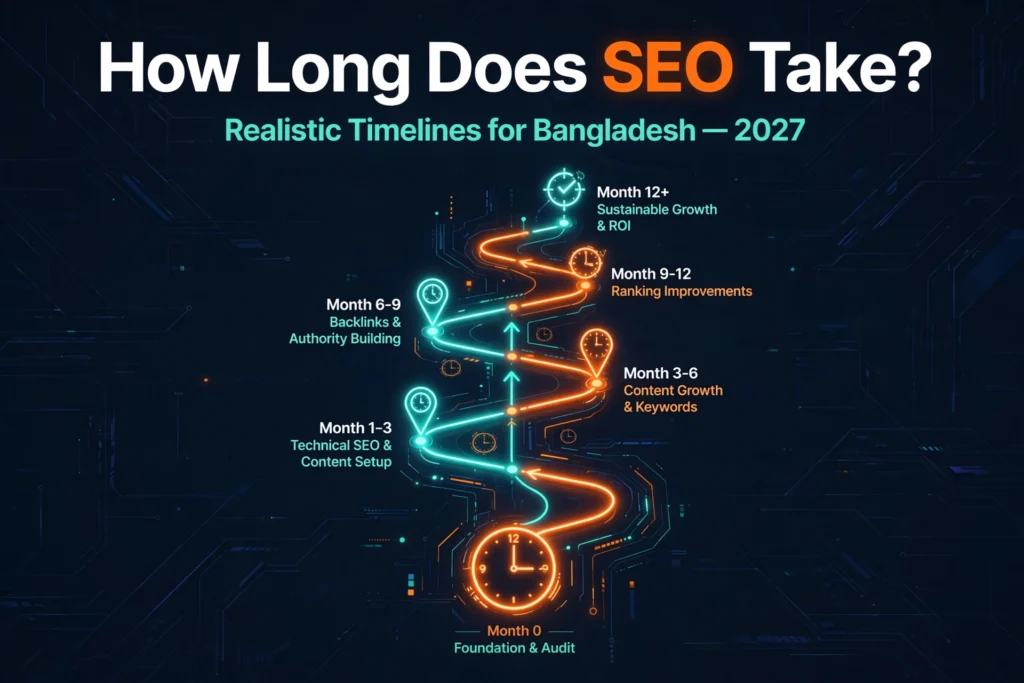
Timelines feel less abstract when you know what the work looks like as it unfolds. Here’s the typical shape of a well-run campaign — and what you should see at each stage:
Month 1: Audit and triage
The work: Full technical audit, Search Console and Analytics baselines, competitor and keyword mapping. The highest-impact fixes ship first: indexation blockers, critical Core Web Vitals failures, broken checkout or contact flows.
What you should see: Little visible movement — this month buys the right to move later. What you should receive: the audit itself, with a prioritized fix list. Any consultant who skips the audit and starts “building links” in week one is guessing.
Months 2–3: Foundation building
The work: Technical debt cleared systematically, site architecture restructured around intent, first content ships — pages built for specific queries the audit identified as winnable. Internal linking starts passing authority to priority pages.
What you should see: Leading indicators: rising impressions, new keywords entering rankings, faster crawling, more pages indexed. If nothing moves here — not even impressions — that’s a diagnostic signal, not patience territory.
Months 4–6: Authority and momentum
The work: Content production continues, digital PR and legitimate link acquisition ramp up, early pages begin compounding. AI-search structuring (FAQ schema, entity signals) starts showing citation pickups.
What you should see: Traffic curves bending upward on a healthy campaign. This is also when under-resourced campaigns stall — because this phase demands consistent output, not a one-time push.
Month 6+: Compounding
The work: Established pages defend and extend positions; new content ranks faster because the site has earned crawl frequency and topical authority.
What you should see: Growth turning less linear and more compounding — sustained traffic, competitive commercial keywords ranking, leads attributable to organic, and AI citations appearing as a second discovery channel. For what compounding looks like at scale, see the RFL Eshop case study — 1.2M+ monthly impressions built exactly this way.
Leading Indicators: How to Tell It’s Working Before Rankings Move
Rankings are a lagging indicator. These tell you the campaign is healthy long before the traffic curve bends — check them monthly in Search Console:
| Indicator | What it tells you | Where to check |
|---|---|---|
| Impressions climbing | Google is showing your pages for more queries — visibility before clicks | Search Console → Performance |
| Average position improving | Pages moving from position 48 to 31 is real progress, even off page one | Search Console → Performance (filter by page) |
| Indexation ratio rising | Submitted vs indexed pages converging — Google accepting your content | Search Console → Pages |
| Crawl stats increasing | Googlebot visiting more often and spending time on important pages | Search Console → Settings → Crawl stats |
| CTR improving | Rewritten titles and meta descriptions earning more clicks per impression | Search Console → Performance (compare periods) |
| AI citations appearing | Your content surfacing inside AI Overviews or chat answers | Manual checks + AI-visibility reporting if your tools support it |
A monthly report should show these, not just a rank-tracker screenshot. If your reporting contains only keyword positions, you’re flying half-blind — and if none of these move by month three, the strategy needs questioning, not more patience.
7 Things That Slow SEO Down in Bangladesh
Some delays are structural; others are self-inflicted. These are the ones I encounter most often in the local market:
- Thin, duplicated, or AI-spun content with no oversight. Mass-produced pages give Google no reason to prefer you — and under current spam policies, scaled low-value content can now trigger enforcement that resets your clock entirely.
- Inconsistent business information. Different phone numbers, addresses, or business names across Facebook, directories, and the website confuse Google’s local understanding and stall map-pack progress for months.
- Changing strategy every 60 days. SEO compounds on consistency. Every new consultant or new “approach” restarts the trust clock — the single most expensive habit in this list.
- No conversion tracking. If leads and sales aren’t attributed, nobody knows which keywords matter — so effort spreads thin across vanity rankings instead of compounding on what converts.
- Technical debt nobody owns. The audit finds the problems; then they sit in a backlog for six months because no developer is assigned. Fixes that never ship don’t rank, and the timeline quietly doubles.
- Targeting only head keywords. Chasing “best restaurant Dhaka” while ignoring hundreds of faster-converting long-tail queries is the slowest possible path to revenue — and to visible wins that sustain stakeholder confidence.
- Ignoring AI search. A growing share of discovery now happens inside AI answers. Content optimized only for blue links misses the channel entirely — see what AI SEO actually involves.
Does a Bigger Budget Make SEO Faster?
Up to a point — but not the way most people expect. Money buys parallel work, not shorter physics. A bigger budget lets you fix technical issues, publish content, and run digital PR simultaneously instead of sequentially, which can compress a 9-month roadmap into 6. What money cannot buy is Google’s trust timeline.
Where budget actually changes the timeline most is removing bottlenecks: paying for developer time so fixes ship this week instead of next quarter, commissioning original research worth citing instead of generic posts, funding proper measurement so winning tactics get doubled down on early. Where budget gets wasted is volume without strategy — fifty thin articles and a thousand cheap links. That isn’t faster SEO; it’s a faster route to a penalty review. If a consultant’s main answer to “how do we go faster” is “spend more with us” without naming the specific bottlenecks the money removes, keep looking.
When You’re Ready to Move Forward
Generic timelines only go so far — your site’s actual timeline depends on its technical state, competition, and history, and the only honest way to estimate it is an audit. The right first conversation with any consultant isn’t “how fast can you rank me” but “what will you find in month one, and what will I see by month three.” Vague answers to that question are the clearest early warning available.
Tanveer Evan Rahat offers AI-driven SEO consultancy for businesses in Bangladesh and internationally, and every engagement starts with that audit: what’s broken, what it’ll take to fix, and what results to expect on what schedule. If you’re currently evaluating consultants, read the complete guide to choosing an SEO consultant in Bangladesh first — then request a free SEO quote and get a timeline built on your site’s data, not a sales script.
Frequently Asked Questions
Can SEO work in under 3 months?
Sometimes, for narrow goals: a local business can appear in the map pack within weeks, and fixing a critical indexation bug can restore lost traffic quickly. But competitive organic rankings in under 3 months are the exception, not the plan — and anyone selling it as the plan is selling something else.
Do Google Ads make SEO faster?
No — paid ads don’t directly influence organic rankings. But they buy useful data (which keywords actually convert) and revenue while SEO compounds, which makes the wait affordable. They complement; they don’t accelerate.
Does a new domain take longer than an old one?
Generally yes. An established domain starts with crawl frequency, existing authority, and historical trust data. A brand-new domain begins at zero on all three — which is why new sites sit at the slow end of every timeline table above.
What if my competitor started SEO years ago?
You don’t need to beat their total history — you need to beat their current pages for specific intents. Competitors with old, thin content are regularly outranked by newer, better-structured pages. The audit tells you where they’re actually vulnerable, and this challenger playbook shows how smaller sites take topics from incumbents.
How long until AI Overviews or ChatGPT cite my content?
Typically a few months behind classic rankings for the same content — AI systems draw on the same trust signals (authority, structured content, entity clarity), so the citation clock starts once those exist. Content with FAQ schema, clear definitions, and original data gets picked up fastest; generic rewritten content rarely gets cited at all.
We’ve done SEO for 8 months with no results. Is it time to quit?
Not necessarily — but it is time for an independent diagnosis. Check the leading indicators above first: if impressions, indexation, and average position have all flatlined, the strategy is broken, not slow. If they’re climbing while revenue lags, the issue may be conversion or keyword targeting, not SEO itself. Either way, eight months with zero movement in any indicator is a strategy problem demanding a second opinion, not more patience.