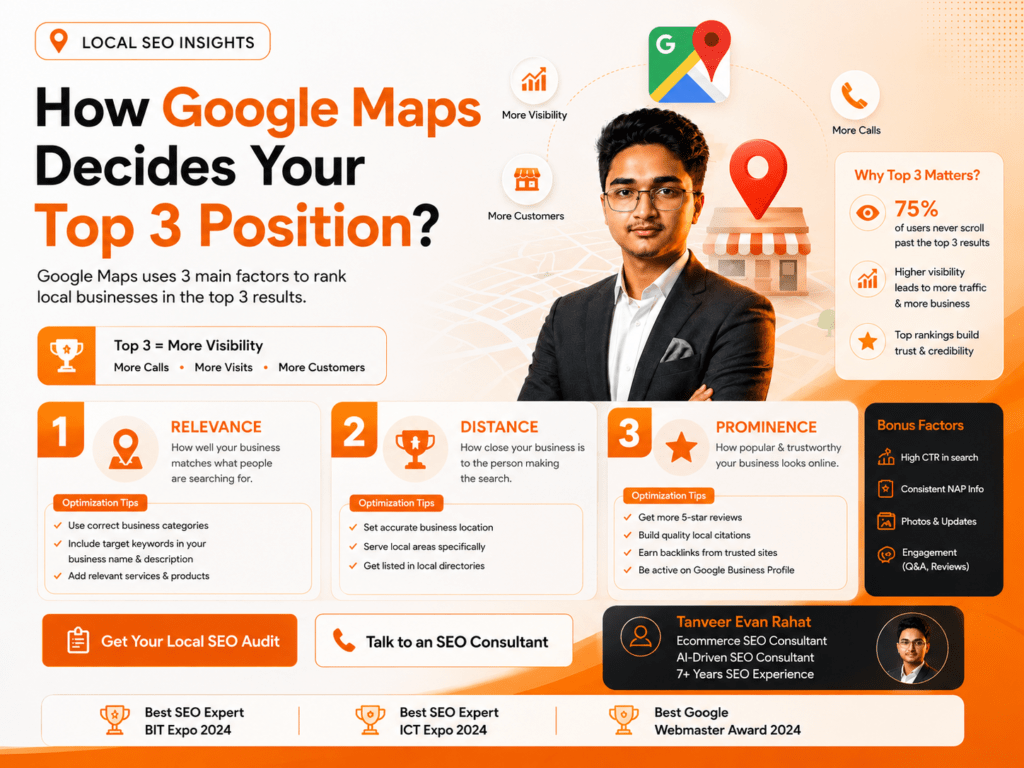
Google Maps ranks the “Top 3” Local Pack results using three confirmed ranking factors — Relevance, Distance, and Prominence — evaluated together, not in isolation. In Bangladesh’s local search environment, most businesses lose Map Pack visibility not because of poor service quality, but because of fixable technical and profile-level gaps: wrong category selection, inconsistent NAP citations, low review velocity, and weak Entity SEO signals. This guide breaks down each ranking factor with real audit patterns from Dhaka, Chattogram, and Sylhet businesses, provides a diagnostic framework to identify exactly which factor is underperforming, and outlines the exact sequence to fix it.
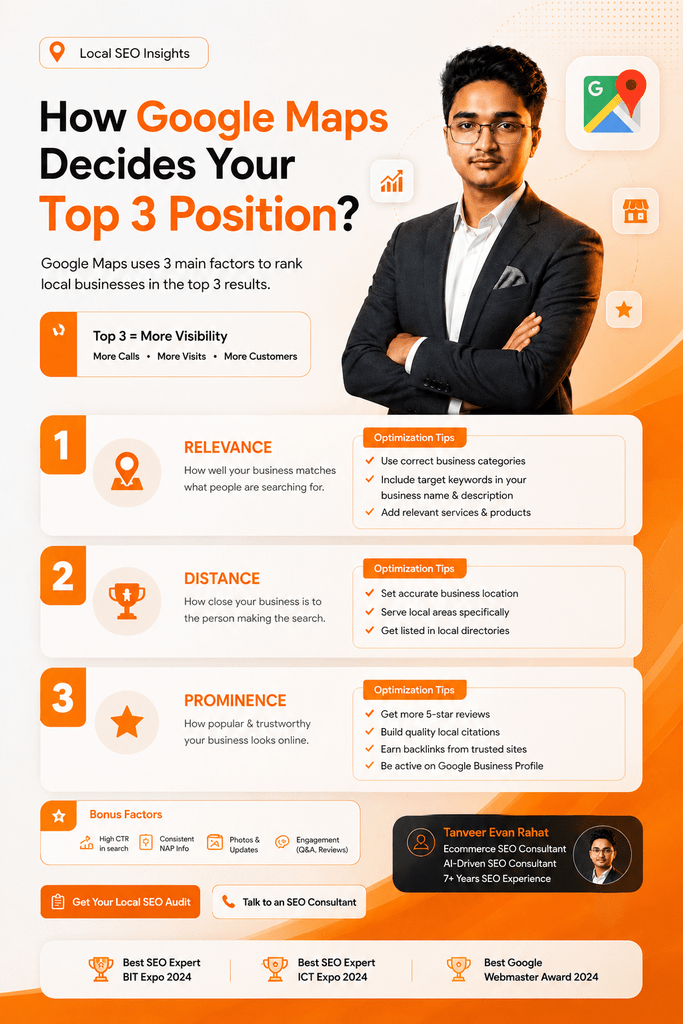
Google Maps decides its Top 3 (Map Pack) results using three factors: Relevance (how well your Google Business Profile matches the search query), Distance (how close your business is to the searcher or searched location), and Prominence (how well-known and trusted your business is, based on reviews, citations, and web authority). Distance is largely fixed; Relevance and Prominence are controllable through proper Local SEO optimization.
Q: How does Google Maps decide the top 3 results?
Google Maps’ Local Pack (Top 3) ranking is determined by three factors working together: Relevance (category accuracy, business description, and profile completeness matching search intent), Distance (physical proximity between the business and the searcher/search location), and Prominence (review volume and quality, citation consistency, backlinks, and overall entity recognition across the web). No single factor guarantees a Top 3 position — Google evaluates all three simultaneously, meaning a business can have excellent reviews but still rank poorly if its category is wrong, or vice versa.
Every week, a business owner asks me a version of the same question: “My service is genuinely better than my competitor’s — why is their business ranking above mine on Google Maps?“
The honest answer is rarely about service quality. It’s about how well the business’s digital footprint — its Google Business Profile, citations, reviews, and web presence — communicates relevance and trust to Google’s Local Algorithm.
After auditing businesses across Dhaka’s Dhanmondi, Gulshan, and Uttara commercial zones, as well as Chattogram and Sylhet, I’ve seen the same pattern repeat itself: business owners obsess over the factor they can’t fully control (distance) while completely ignoring the two factors they absolutely can control — relevance and prominence.
This guide exists to remove the guesswork. By the end, you’ll understand exactly which of the three ranking factors is holding your business back, and precisely what sequence of fixes will move you toward the Google Maps Top 3.
1. What Is the Google Maps Local Pack (Top 3)?
When someone searches “dentist near me” or “SEO expert in Dhaka,” Google displays a map with three business listings above the traditional organic search results. This is the Local Pack, also called the Map Pack or 3-Pack.
Appearing in this Top 3 is disproportionately valuable — studies on click behavior consistently show that Local Pack listings capture the overwhelming majority of clicks for local-intent searches, far outpacing traditional organic listings below them. For Bangladeshi businesses competing in physical-location industries — clinics, restaurants, agencies, retail, home services — the Map Pack is often the single highest-value piece of digital real estate available.
2. The Three Official Google Maps Ranking Factors
Google has directly confirmed that Local Pack rankings are determined by three factors:
| Factor | What It Measures | Controllability |
|---|---|---|
| Relevance | How well your profile matches the search intent | High — fully controllable |
| Distance | Physical proximity to the searcher/search location | Low — mostly fixed |
| Prominence | Overall reputation and web authority | High — controllable, but compounds over time |
Understanding this table alone resolves most of the confusion I encounter during audits. Businesses often ask “why isn’t my SEO working” when the real issue is a controllable factor (Relevance or Prominence) that’s been completely neglected.
3. Factor 1: Relevance — Deep Breakdown
Relevance is Google’s attempt to answer: does this business actually match what the person is searching for?
Category Selection
This is the single highest-impact relevance lever, and the most commonly mismanaged. I regularly find businesses using an overly broad primary category (“Restaurant”) when a specific one (“Bengali Restaurant,” “Biryani Restaurant”) would dramatically improve match accuracy for their actual target searches.
Business Description & Services Section
Google reads your services list and business description to understand what you offer. This content should mirror the natural language customers actually use — not internal jargon.
Profile Completeness
Attributes (accessibility, payment options, service options), business hours, and Q&A responses all feed into how confidently Google can match your profile to a query.
For a full walkthrough of fixing these elements, see our dedicated Google Business Profile Optimization service, where we cover category audits and attribute optimization in detail.
4. Factor 2: Distance — What You Can and Can’t Control
Distance measures the gap between the searcher’s location (or the location term used in the query) and your business address. This factor is largely fixed — you cannot move your physical location for every search.
What you can influence:
- Service area configuration for businesses that travel to customers (home services, contractors)
- Multi-location profiles, each independently optimized, to extend coverage across Dhaka’s different zones
- Location-specific landing pages that reinforce geographic relevance signals for each area you legitimately serve
This is precisely why our Hyper-Local SEO Services are built around service-area mapping — extending visibility for businesses that operate across multiple neighborhoods rather than a single fixed address.
5. Factor 3: Prominence — Where the Real Competition Happens
Prominence is the compounding, ongoing factor that separates businesses that dominate the Map Pack from those stuck on page two. It reflects how well-known and trustworthy Google — and increasingly, AI systems — perceive your business to be.
Review Signals
Volume, average rating, recency, and response rate all feed prominence. A business with 140 recent, responded-to reviews signals far more established trust than one with 8 reviews from three years ago.
Citation Consistency
Your Name, Address, and Phone number (NAP) must match exactly across every directory. Inconsistent citations are one of the most common — and most overlooked — prominence killers I find during audits. A full breakdown of directory-level citation strategy is covered in our Best Business Directories in Bangladesh guide.
Backlinks and Entity Recognition
Mentions from local news, industry directories, and genuine partnerships all reinforce prominence. Increasingly, this extends into Entity SEO — how clearly Google’s Knowledge Graph, and AI systems like Gemini and ChatGPT, recognize your business as a legitimate, citable entity. Our Semantic SEO and Generative SEO services address this evolving layer directly.
6. How the Three Factors Interact (Decision Framework)
The mistake most businesses make is treating these factors independently. In reality, they compound:
| Scenario | Relevance | Distance | Prominence | Likely Outcome |
|---|---|---|---|---|
| A | High | High | Low | Underperforms weaker competitors with better reviews/citations |
| B | Low | High | High | Loses specific searches despite strong reputation |
| C | High | Low | High | Still competitive for broader searches; loses hyperlocal ones |
| D | High | High | High | Dominates the Top 3 consistently |
Use this table as a self-diagnostic. If your business matches Scenario A or B, the fix isn’t “more SEO” broadly — it’s a specific, targeted correction.
7. Illustrative Ranking Audit: Bangladeshi Business Data
The following data is illustrative, based on aggregated patterns observed across client audits in Dhaka, and is presented to demonstrate typical ranking-factor gaps — not as verified statistics for any single business.
| Ranking Factor | Businesses Scoring Well | Businesses Scoring Poorly |
|---|---|---|
| Correct Primary Category | ~38% | ~62% |
| NAP Consistency Across 10+ Directories | ~29% | ~71% |
| Active Review Response (last 90 days) | ~22% | ~78% |
| Complete Profile Attributes | ~41% | ~59% |
This pattern illustrates why Prominence-related fixes (citations, review response) typically produce the largest visibility gains — they’re the most neglected, not the most difficult to fix.
8. Case Study: Dhanmondi Diagnostic Center
A diagnostic center in Dhanmondi came to us essentially invisible in local search despite years of operation and consistent service quality. The audit revealed:
- Relevance gap: Primary category didn’t accurately represent their core diagnostic services
- Prominence gap: Minimal review volume, combined with inconsistent NAP citations across three major directories
The fix sequence: category correction → profile attribute completion → citation cleanup across directories → structured, ethical review generation process.
Outcome: The business reached the #1 position in the Google Local 3-Pack for its core service category. Full methodology is documented in our published case studies, alongside our RFL Group organic traffic case study showing similar principles applied at enterprise scale.
9. Step-by-Step: How to Diagnose Your Own Ranking Gap
- Search your own business category in an incognito browser from your target city
- Note your Map Pack position — or absence — and screenshot the top 3 competitors
- Compare category selection against your own listing
- Search your business name + address across 5–10 major directories to check NAP consistency
- Count and evaluate reviews — volume, recency, and whether you’ve responded
- Check profile completeness — attributes, photos, Q&A, business description
- Map your findings against the Decision Framework table in Section 6 to identify your primary gap
If this process feels overwhelming to do manually, our Free SEO Audit Tool automates the first five steps.
10. Common Mistakes That Kill Map Pack Rankings
- Selecting a broad category instead of the most specific accurate one
- Treating the Google Business Profile as “set and forget” after initial setup
- Buying fake reviews — increasingly detected and penalized by Google’s spam systems
- Ignoring negative reviews instead of responding professionally
- Inconsistent business names across directories (e.g., “Dr. Rahman Dental” vs. “Rahman Dental Clinic”)
- Assuming a well-designed website alone will fix Map Pack invisibility
- Neglecting service-area configuration for multi-location or mobile businesses
11. Google Maps SEO vs. Traditional Website SEO
| Aspect | Google Maps SEO | Traditional Website SEO |
|---|---|---|
| Primary ranking surface | Map Pack / Local Pack | Organic blue links |
| Core factors | Relevance, Distance, Prominence | Content, backlinks, technical health |
| Key asset | Google Business Profile | Website domain authority |
| Review impact | Direct ranking factor | Indirect (trust signal only) |
| Local intent | Extremely high weight | Moderate weight |
| Best for | Physical-location businesses | Ecommerce, national brands, content sites |
Both systems should work together — our Core SEO Services integrate technical website SEO with Local Pack optimization rather than treating them separately.
12. The Evolving Role of AI in Local Rankings (2026 Update)
As AI Overviews, Gemini, and ChatGPT increasingly influence how people discover local businesses, Prominence is expanding beyond traditional citations into broader Entity SEO — structured data, consistent cross-platform information, and recognized topical authority. Businesses optimizing only for the traditional three factors while ignoring this AI-driven layer risk becoming invisible in AI-generated local recommendations, even while maintaining decent traditional Map Pack visibility. This shift is explored in depth in our guide on what AI SEO actually means and our broader AI-Driven SEO in Bangladesh 2026 analysis.
13. Local SEO Checklist for Bangladeshi Businesses
- Primary category is the most specific accurate option
- Business description uses natural customer language
- NAP matches exactly across all directories
- Minimum 4.3+ average review rating maintained
- Active review response within 48 hours
- Weekly GBP posts and photo updates
- Service area properly configured (if applicable)
- Schema markup implemented on website
- Location pages built for each service area
14. Timeline: How Long Does It Take to Reach Top 3?
| Timeframe | Typical Milestone |
|---|---|
| Week 1–2 | Audit complete, category/profile corrections implemented |
| Week 3–6 | Citation cleanup across directories completed |
| Month 2–3 | Review velocity increases, initial ranking movement visible |
| Month 3–5 | Consistent Top 3 positioning for primary category terms |
| Month 6+ | Expansion into secondary keyword rankings and AI citation visibility |
Timelines vary by competition density — Dhaka’s Gulshan and Banani commercial zones are considerably more competitive than emerging suburban markets.
15. Expert Tips & Frequently Ignored Details
- Tip: Q&A sections on your GBP are frequently ignored by competitors — seed and answer your own common customer questions proactively.
- Tip: Review responses that naturally mention your service and location reinforce relevance signals, not just customer relations.
- Ignored Detail: Duplicate GBP listings (often created accidentally) actively dilute prominence signals by splitting reviews across two profiles.
- Ignored Detail: Photo geotagging and regular photo uploads correlate with stronger engagement signals Google tracks.
Frequently Asked Questions
Does Google Maps ranking affect my website’s organic Google ranking?
Not directly, but they reinforce each other. A well-optimized website supports Entity SEO and Prominence signals, indirectly benefiting Map Pack visibility.
How many reviews do I need to reach the Top 3?
There’s no fixed number — it depends on your competition density. What matters more is consistent, ongoing review velocity relative to your top competitors, not a specific total.
Can I rank in the Top 3 without a physical address?
Only for service-area businesses using Google’s service-area business (SAB) profile type. Businesses without a qualifying service-area setup generally cannot compete meaningfully in Map Pack results.
Does responding to negative reviews hurt my ranking?
No — professional, prompt responses to all reviews, including negative ones, are treated as a positive engagement signal.
How is Map Pack ranking different for multi-location businesses?
Each location requires its own fully optimized, independently verified Google Business Profile. Duplicate content or copy-pasted descriptions across locations weaken relevance for each.
Will AI Overviews replace the Google Maps Top 3?
Not currently — but AI Overviews increasingly surface local business recommendations alongside the Map Pack, making Entity SEO and structured data increasingly important alongside traditional ranking factors.
Key Takeaways
- Google Maps ranks the Top 3 using Relevance, Distance, and Prominence — evaluated together, not independently
- Relevance and Prominence are fully controllable; Distance is mostly fixed
- Citation inconsistency and neglected review management are the two most common, most fixable prominence gaps
- Category selection is the single highest-impact relevance lever
- AI search systems are extending Prominence into broader Entity SEO territory
Summary
Reaching the Google Maps Top 3 isn’t about chasing algorithm secrets — it’s about systematically strengthening the two factors within your control while working intelligently within the constraints of the one you can’t. Businesses that treat Relevance, Distance, and Prominence as one interconnected system consistently outperform those optimizing a single factor in isolation.
Strong CTA
If you’re unsure exactly which of these three factors is holding your business back, don’t guess. Book a Free Local SEO Audit and get a clear, data-backed diagnosis of your Google Maps ranking gaps — reviewed personally, not by a junior account manager.
📍 17th Floor, Rupayan Trade Center, Dhaka 1205, Bangladesh
📞 01980-934436 | 📧 [email protected]
About the Author & Editorial Policy
Author: Tanveer Evan Rahat — Local SEO Consultant, AI-Driven SEO Consultant, Founder of NexaForge IT. 7+ years of experience across 1,200+ businesses and 2,500+ projects in Bangladesh, UK, US, Canada, Europe, and Australia. Recognized at BIT Expo 2024, ICT Expo 2024, and the Google Webmaster Award. Full background: About Tanveer Evan Rahat.
Editorial Policy: This article is based on direct client audit patterns and publicly confirmed Google ranking factors. Illustrative data in Section 7 is clearly labeled as representative, not verified statistical data. Content is reviewed and updated periodically to reflect algorithm changes.
Last Updated: This page is maintained and updated as Google’s local ranking systems evolve.
Disclaimer: SEO results vary by industry, competition, and market conditions. No specific ranking outcome is guaranteed.