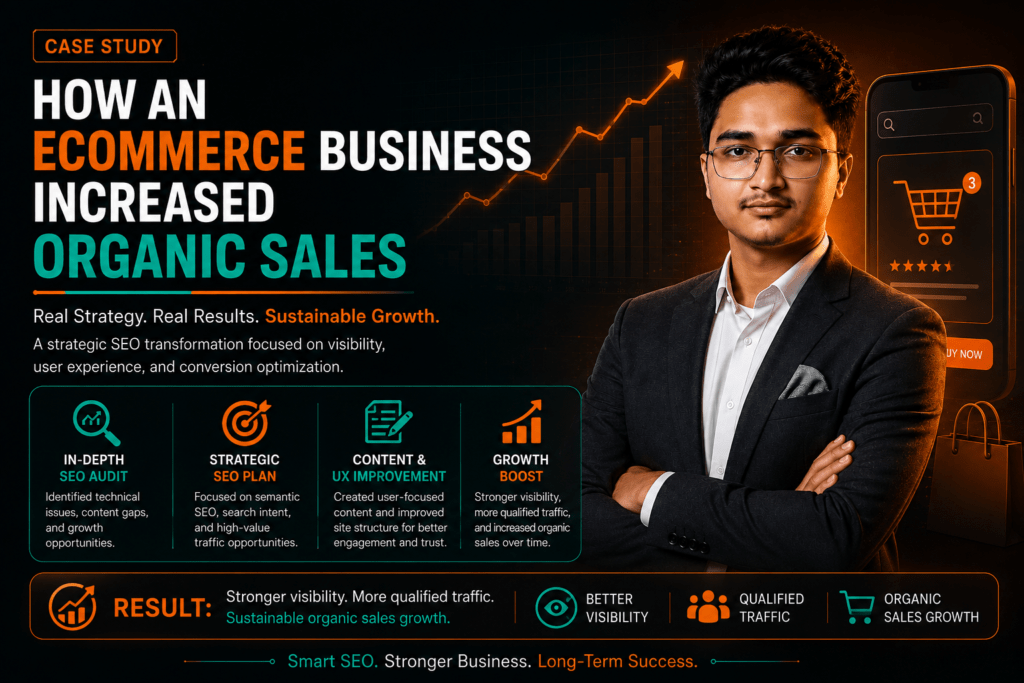
Organic search grows ecommerce sales by ranking product and category pages for the exact terms buyers already search — without a recurring ad budget. In one real engagement, an ecommerce brand’s organic traffic grew from 389 to 96,600 monthly visitors, and its ranked keywords went from 4 to over 8,000, using a five-phase SEO framework built around technical fixes, product-page optimization, and content authority — not paid placement.
Executive Summary
Most ecommerce businesses treat ads as the default growth channel and SEO as an afterthought. This article breaks down a real, documented case — an ecommerce brand that built its sales growth almost entirely on organic search — and the exact five-phase framework used to get there. You’ll get the process, the mistakes that block most stores from replicating it, a decision framework for balancing Google ads vs. organic, and a step-by-step starting point for your own store.
Why Ecommerce Businesses Default to Ads (And Where That Breaks Down)
Ads feel controllable. Set a budget, launch a campaign, watch sales come in the same week. Organic ecommerce SEO doesn’t offer that immediacy, so most stores treat it as a “someday” project instead of a core channel.
The problem shows up later, not immediately:
- Customer acquisition cost (CAC) rises every quarter as competitors bid up the same keywords and audiences
- Growth stops the day the budget stops — paid traffic doesn’t compound, it just repeats
- Platform dependency becomes a business risk — a policy change, account suspension, or CPM spike can wipe out your main channel overnight
- Organic-ranking competitors accumulate an advantage you can’t buy your way past — a product page that’s ranked #1 for two years has trust signals a new ad campaign can’t replicate
None of this means ads are wrong. It means treating them as the only growth lever is a ceiling, not a strategy. Organic search is the channel that keeps working after you stop paying for it — which is exactly what shows up in the case below.
The Real Case: An Ecommerce Brand That Grew Almost Entirely Through Organic Search
In 2022, RFL Group — Bangladesh‘s leading home appliance manufacturer — brought on a full ecommerce SEO engagement for their online store, rflbd.com. At the time, the site had 389 monthly organic visitors and 4 ranked keywords. Its domain authority score was a 4, and it had essentially no presence in AI search systems, because AI search barely existed yet.
By 2026, the same site’s organic channel — not blended traffic, not paid traffic — looked like this:
| Metric | 2022 (Before) | 2026 (After) |
|---|---|---|
| Monthly organic traffic | 389 | 96,600+ |
| Keywords ranked | 4 | 8,000+ |
| Authority score | 4 (Low) | 40+ (High) |
| Referring domains | 242 | 9,100+ |
| Backlinks | 453 | 34,100+ |
| AI search mentions (ChatGPT, Gemini, AI Overviews, AI Mode) | 0 | 223 |
That’s a documented, sustained organic growth curve — the kind that keeps compounding because it isn’t tied to a monthly ad spend. The full breakdown, including the client’s own account of the engagement, is in the complete RFL Group case study →.
What matters for your store isn’t the specific numbers — every catalog, niche, and starting point is different. What matters is the framework that produced them, because that part is replicable.
The Five-Phase Framework Behind Organic Ecommerce Growth
This is the same structured process used across ecommerce engagements, adapted for a catalog-driven store rather than a single landing page.
Phase 1: Audit & Entity Assessment (Weeks 1–2)
Before touching anything, the store gets a full technical and competitive audit — crawlability, indexation of product and category pages, Core Web Vitals, and an assessment of how Google’s systems currently understand the brand as an entity. For ecommerce specifically, this means checking for duplicate product descriptions (a common issue when descriptions are copied from suppliers), faceted-navigation crawl waste, and orphaned category pages.
Phase 2: Foundation & Semantic Mapping (Months 1–2)
This is where product schema markup, structured category architecture, and keyword-to-category mapping get built. Every product and category page needs to map to real buyer language — not just the internal SKU names a business uses for itself. A “4-burner gas stove” internally might need to rank for “best gas stove for family of 4,” and those aren’t the same optimization task.
Phase 3: Technical & On-Page Execution (Ongoing)
Page speed, internal linking between related products and categories, canonical tag cleanup (critical for stores with size/color variant URLs), and structured data implementation. Ecommerce sites lose more ranking potential to technical debt than almost any other business type, simply because catalogs scale faster than technical maintenance does.
Phase 4: Authority Signals & Content (Months 3–6)
Category and buying-guide content that answers real pre-purchase questions, combined with white-hat link acquisition. This is also where information gain matters most — a generic “best products for X” post that just repeats what’s already ranking won’t move anything. Content has to add something the SERP doesn’t already have.
Phase 5: AI Optimization & Reporting (Ongoing)
Structuring product and category content so it’s citable by AI Overviews, ChatGPT, and Gemini — increasingly where pre-purchase research happens before a buyer ever lands on a store. Paired with transparent monthly reporting on traffic, rankings, and now AI visibility, not just Google rankings alone.
What a Realistic Growth Timeline Looks Like
Illustrative example — not a guarantee. Actual results depend on your niche, competition, and starting technical condition.
| Timeframe | What’s Typically Happening | What You’ll Likely See |
|---|---|---|
| Weeks 1–2 | Audit, technical fixes identified | No visible traffic change yet |
| Months 1–3 | Schema, on-page, and technical fixes go live | Early indexing improvements, minor keyword movement |
| Months 3–6 | Content and authority building compound | First meaningful organic traffic and sales lift |
| Months 6–12 | Authority and AI citations build | Category-level rankings, sustained sales growth |
| Year 2+ | Compounding effect | Growth continues without proportional cost increase |
The pattern that matters: paid traffic is flat until the budget stops, then it’s zero. Organic traffic is slow until it compounds, then it keeps growing. Most businesses quit organic SEO in month 3 or 4 — right before the compounding phase starts.
Organic-Led Growth vs. Ad-Led Growth: A Practical Comparison
| Factor | Ad-Led Growth | Organic-Led Growth |
|---|---|---|
| Speed to first sale | Immediate | Weeks to months |
| Cost behavior over time | Rises as competition increases | Flat or decreasing cost per acquisition |
| What happens if you stop | Traffic drops to zero immediately | Traffic persists, often for years |
| Platform risk | High — algorithm/policy changes hit directly | Lower — diversified across search & AI engines |
| Builds long-term brand equity | Limited | Significant — rankings function as trust signals |
| Best for | Launches, promotions, time-sensitive offers | Sustainable, compounding revenue |
Neither column is “wrong.” The businesses that grow best usually run both — but the ones stuck on a growth plateau are almost always running ads exclusively, with organic search as an afterthought.
Step-by-Step: Where to Start This Quarter
- Run a full technical and content audit of your store — identify duplicate product descriptions, broken canonical tags, and unindexed category pages. (Get a free audit →)
- Map your top 20 products and categories to real buyer search terms — not internal naming conventions.
- Fix product schema markup so Google and AI systems can read price, availability, and reviews directly.
- Rewrite your five highest-traffic-potential product descriptions to be genuinely useful, not supplier boilerplate.
- Build one strong buying-guide page per major category — answering the pre-purchase questions your customers are already asking.
- Set a 6-month measurement point, not a 6-week one — this is the single biggest reason ecommerce SEO efforts get abandoned before they work.
Common Mistakes That Block Ecommerce SEO Results
- Judging results at 6 weeks instead of 6 months. Organic growth compounds; it doesn’t spike.
- Using manufacturer/supplier product descriptions unchanged. If ten other stores use the same text, Google has no reason to prefer yours.
- Ignoring faceted navigation and filter URLs, which can quietly create thousands of thin, duplicate pages that waste crawl budget.
- Treating category pages as an afterthought when they’re often higher-value ranking targets than individual product pages.
- Stopping content and link-building the moment traffic starts moving — this is exactly when momentum should be reinforced, not paused.
Should You Invest in Organic SEO, Ads, or Both? A Decision Framework
- Launching a new store with zero traffic and need revenue this month? → Start with ads, begin SEO in parallel — don’t wait to start the compounding clock.
- Established store with 1+ years of sales history and rising CAC? → Organic SEO should become the primary growth investment; use ads for promotions only.
- Small catalog (under 50 products), high margin? → Organic SEO offers strong ROI relatively fast — fewer pages to optimize, faster to dominate a niche.
- Large catalog (500+ SKUs), low margin per item? → Prioritize technical SEO and category-page optimization first; content depth matters less than crawlability and structure at this scale.
- Seasonal or trend-driven business? → Use ads for the spike periods, organic SEO for the evergreen core catalog that sells year-round.
Frequently Asked Questions
Can a small ecommerce store really compete without a big ad budget?
Yes — organic SEO rewards relevance and technical quality more than budget size. A small store with a clean, well-structured catalog and genuinely useful product content can outrank larger competitors with weak technical SEO, especially in specific product niches rather than broad categories.
How is ecommerce SEO different from general website SEO?
Ecommerce SEO deals with challenges general SEO doesn’t — faceted navigation, product variant URLs, out-of-stock page handling, and product schema markup. It also optimizes for transactional and comparison intent specifically, not just informational search.
Does this work for both Shopify and WooCommerce stores?
Yes, the framework applies to any ecommerce platform. The technical execution differs — Shopify and WooCommerce handle canonical tags, schema, and URL structure differently — but the five-phase process itself is platform-agnostic.
How long before organic traffic actually converts to sales?
Traffic typically arrives before conversions stabilize. Expect initial traffic movement in months 1–3, with a meaningful, sales-relevant lift typically appearing in months 3–6, once ranked pages start attracting genuine buyer-intent search terms rather than just informational traffic.
Is organic growth risky if Google changes its algorithm?
Less risky than paid channels, not risk-free. Diversifying across traditional Google Search, AI Overviews, and AI chat platforms (ChatGPT, Gemini) — as covered in Phase 5 above — reduces dependency on any single ranking system.
Key Takeaways
- Ads deliver speed; organic search delivers compounding growth that doesn’t stop when the budget does.
- A documented, real ecommerce case shows organic traffic growing from 389 to 96,600+ monthly visitors using a structured five-phase process — not luck or budget size.
- Most ecommerce SEO failures come from abandoning the process around month 3, right before it compounds.
- The right question isn’t “SEO or ads” — it’s which one fits your store’s current stage, catalog size, and margin.
Ready to See What This Looks Like for Your Store?
A free audit will show you exactly where your store is losing organic visibility — and what a realistic 6-month plan looks like for your specific catalog and niche.
Get a Free Ecommerce SEO Audit → · Explore Ecommerce SEO Services → · Book a Strategy Call →