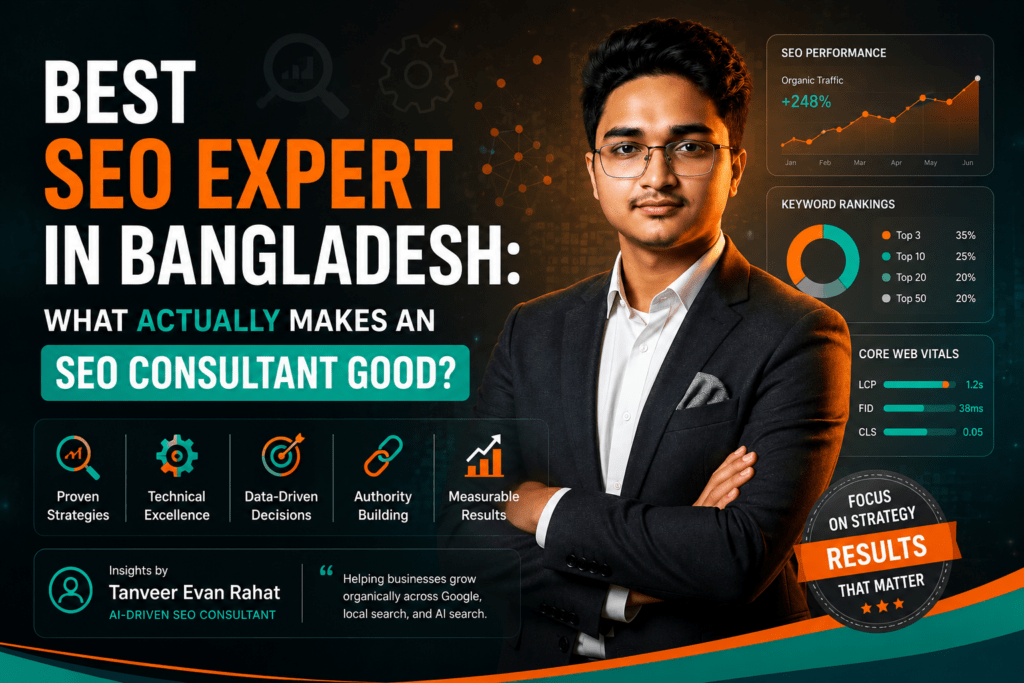
Every SEO freelancer in Bangladesh calls themselves an expert. Every agency homepage promises “guaranteed rankings.” The word “best” costs nothing to put on a website, which means it tells you nothing useful.
What actually separates a good SEO consultant from a mediocre one isn’t a title. It’s a specific, checkable set of behaviors and evidence. This is that checklist, not a sales pitch for any one person, but the actual criteria you should be testing before you hire anyone.
(If you want to see these criteria applied to specific, named professionals with real data, our full comparison of Bangladesh’s top SEO experts does exactly that. This piece is the shorter, evergreen version — what to look for, regardless of who you’re evaluating.)
1. Their Own Website Proves It, Not Just Claims It
Before anything else, check whether the consultant can rank their own site.
Search their name. Search “SEO expert in Bangladesh” or whatever their target term is. Do they show up — not just for their brand name, but for the competitive terms they’d presumably want to rank you for? Run their domain through a free tool like Semrush or Ubersuggest and look at actual traffic and keyword counts, not just a polished homepage.
A consultant whose own site loads slowly, has thin content, or is invisible for anything beyond their own name is showing you their methodology in action — just not the way they intended.
2. Case Studies Include URLs You Can Check Yourself
“We grew a client 300%” means nothing without a way to verify it. A real case study gives you:
- The actual client name and domain
- A baseline number and a current number
- A timeframe
- A way to confirm it independently — Google Search Console screenshots, or third-party data from Semrush/Ahrefs that anyone can pull up themselves
If a consultant can point you to a domain and say “check it yourself,” that’s a different category of evidence than a slide with a percentage on it. Our documented RFL Group case study is built this way specifically so it doesn’t require trusting anyone’s word.
3. Recognition Comes From Somewhere Other Than Themselves
Awards and certifications aren’t automatically meaningless — but there’s a real difference between recognition that required beating other candidates in front of independent judges, and a certificate anyone can buy after watching a video course.
Ask specifically: who organized this award, and were other people evaluated for it? Industry events like BIT Expo or ICT Expo (Bangladesh Computer Samity) involve actual selection processes. A “certified” badge from a paid online course does not.
4. They Can Explain AI Search Without Reciting a Definition
By 2026, this isn’t optional knowledge anymore. Ask directly: “How would you get my business cited inside a Google AI Overview or a ChatGPT answer?”
A consultant who actually does this work will talk about structured data, FAQ schema, entity signals, and E-E-A-T — specific mechanisms. A consultant who says “we write high-quality content optimized for AI” and stops there is describing the concept, not the method. What AI SEO actually involves is a useful benchmark to read before that conversation, so you know what a real answer sounds like.
5. Pricing Follows an Audit, Not the Other Way Around
Be skeptical of anyone who quotes a fixed monthly price before seeing your website.
SEO scope depends entirely on what’s actually wrong or missing — a five-page brochure site and a 3,000-product e-commerce catalog cannot responsibly get the same quote. A consultant who prices before auditing is selling a package, not a strategy. One who audits first and prices based on what your site genuinely needs is doing the more honest — and usually more cost-effective — version of the job.
6. Timelines Are Realistic, Not Reassuring
“First page in 30 days” is not a confident promise. It’s either a keyword with zero real competition, or a method that risks a Google penalty later.
A consultant worth hiring will tell you: technical fixes show up in weeks, early movement on lower-competition terms in a few months, meaningful results on competitive terms in four to six months minimum, and compounding growth over a year or more. That’s not a weaker pitch — it’s an honest one.
7. Their Published Content Is the Portfolio You Don’t Have to Ask For
A consultant’s own blog is a live sample of their thinking. Read a few articles. Is there real depth, or is it thin text stretched around a keyword? Is it structured with clear headings, FAQs, and answers you could actually use — the same structure they’d presumably apply to your content?
If their own content strategy looks like an afterthought, that’s a preview, not an exception.
Red Flags Worth Naming Directly
- Guaranteed rankings. No one controls Google’s algorithm. Anyone promising a specific position is either inexperienced or planning to use tactics that risk a penalty.
- Vague answers about AI search. “We focus on quality content” is not an AI SEO strategy — it’s a sentence that avoids one.
- Testimonials with no names attached. Anonymous praise is unverifiable by definition.
- A blog that hasn’t been updated in months, on a site selling ongoing SEO services.
- No mention of technical SEO at all — a strategy built entirely around content and links, with nothing about crawlability, indexing, or site speed, is missing half the discipline.
The One-Meeting Test
If you only have a single call to evaluate someone, ask these four questions and pay attention to specificity, not confidence:
- “Show me a case study with a real client URL I can check.”
- “How would you get my business cited in an AI Overview or ChatGPT?”
- “What would you actually price this at, and why — before or after seeing my site?”
- “What’s a realistic timeline for [your specific goal], and why?”
A consultant who answers all four with specifics, not reassurance, has probably done this before. One who answers with confidence but no detail hasn’t been tested yet — by you or anyone else.
Where This Leads
None of this is abstract. If you want to see these exact criteria applied to specific, named SEO professionals currently working in Bangladesh — with real traffic data, award records, and side-by-side comparison — read the full data-driven comparison.
If you’re earlier in the process and want the complete buyer’s guide — pricing ranges, timelines, agency vs. freelancer, how to audit your own site first — the complete guide to choosing an SEO expert in Bangladesh covers all of it in depth.
And if part of what you need is specifically technical — Core SEO, AI SEO, or Local SEO — those service pages go into what that specific work actually involves.
Frequently Asked Questions
What makes an SEO consultant actually good, in one sentence?
Verifiable evidence — a rankable website of their own, checkable case studies, independent recognition, and honest, specific answers about AI search and pricing — rather than confident claims that can’t be checked.
Is a more expensive SEO consultant automatically better?
No. Price should reflect audit findings and actual scope of work, not seniority alone. A consultant who prices before auditing your site — expensive or cheap — is skipping the step that determines whether the price is honest.
How do I know if an SEO consultant understands AI search?
Ask them to explain, specifically, how they’d get your business cited in a Google AI Overview or a ChatGPT answer. A real answer mentions structured data, entity signals, and E-E-A-T. A vague answer about “quality content” usually means they haven’t done this work yet.
Should I trust testimonials on an SEO consultant’s website?
Named testimonials with checkable businesses carry more weight than anonymous praise. The stronger evidence is a case study with a real domain you can independently verify on a tool like Semrush.
How long should I expect to wait before judging results?
Technical improvements can show up within weeks. Meaningful ranking movement on competitive terms typically takes four to six months. Anyone implying faster is either targeting easy, low-value keywords or using risky tactics.
About This Article
Written by Tanveer Evan Rahat, SEO Consultant and AI-Driven SEO Strategist, Founder of NexaForge IT. This piece reflects criteria drawn from direct client work across Bangladesh and international markets — not a ranking of any specific individual. For a named, data-driven comparison, see the linked comparison article above.