Quick Answer
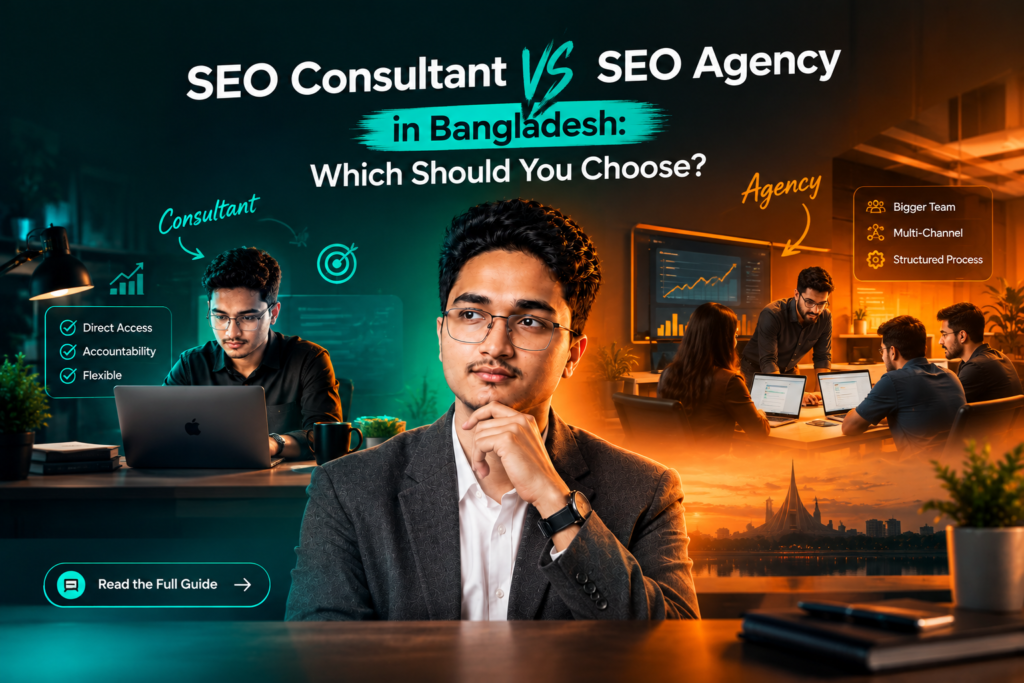
There is no universally better option — only the better fit for your situation. An independent SEO consultant gives you senior-level expertise, direct communication, and usually better value when you need depth rather than headcount. An SEO agency makes sense when you need scale: multiple workstreams, content production, and outreach running in parallel. A digital marketing generalist who lists SEO as one item on a long menu is rarely the right choice for SEO specifically. Whichever model you consider, the single most revealing question is the same: “Who specifically will work on my account, and can I see their individual track record?”
What’s Actually Changed About This Decision by 2027
The consultant-vs-agency question is old; the context around it is new. Three shifts matter for how you evaluate the options now:
AI-search capability is the new dividing line. It no longer matters much whether a provider calls itself a consultant or an agency — what matters is whether anyone on your account can actually execute entity SEO, structured data strategy, and AI-citation optimization for Google AI Overviews, ChatGPT, and Gemini. Most Bangladeshi agencies still sell 2019-era checklists under 2027 branding. Ask for a client example of AI citations, not a service-list bullet.
The “who does the work” problem got worse. Agencies increasingly staff execution with juniors armed with AI content generators — which is exactly the scaled-content-abuse pattern Google’s spam policies now penalize. A recognizable agency brand executed by an unsupervised junior team is not a safer choice than a freelancer; it is a more expensive version of the same risk.
Verification is cheap, so opacity is a choice. You can check any provider’s own domain on Semrush’s free tier in under a minute. A model that hides behind account managers and refuses to name the people doing the work is choosing opacity in an era when transparency costs nothing.
The decision framework below accounts for all three. Use it before you compare prices — price only means something once the model fits.
The 5-Question Decision Framework
Work through these in order. Your answers will point to the right model more reliably than any sales pitch.
1. What is your realistic monthly budget?
Why it matters: Budget determines which model can actually deliver expertise rather than just activity. Under roughly ৳30,000–৳50,000/month, an independent consultant gives you far more expertise per taka than an agency retainer at the same price — because none of your money funds overhead.
How to answer it: Be honest about what you can sustain for 9–12 months, not what you can stretch for one quarter. SEO compounds on consistency; a budget that collapses in month four wastes months one through three.
What the answer points to: Under ~৳50,000/month → consultant. Above that, with genuine multi-workstream needs → agency becomes viable.
Red flag: A provider of either type who never asks about your budget before quoting — they are selling a package, not fitting a solution.
2. How large and complex is your website?
Why it matters: Depth and scale are different problems. A 10-page brochure site needs diagnostic depth; a 5,000-product e-commerce store needs parallel execution across technical, content, and outreach simultaneously.
How to answer it: Count honestly: pages, products, locations, languages. Then ask whether the bottleneck is knowing what to do (strategy) or having hands to do it (volume).
What the answer points to: Small-to-medium site with a strategic problem (stagnant rankings, technical debt, AI invisibility) → consultant. Large site needing content production, technical implementation, and outreach at the same time → agency.
Red flag: An agency pitching a 10-page site, or a solo consultant promising to personally write 200 product descriptions a month. Both are mis-selling.
3. Do you need specialization or execution volume?
Why it matters: This is the question most buyers skip, and it is the one that decides outcomes. Specialization solves “we don’t know what’s wrong”; volume solves “we know what’s wrong and need it done at scale.”
How to answer it: If your problem is diagnostic — rankings stalled despite effort, traffic dropped mysteriously, AI search invisible — you need a specialist’s judgment. If the strategy is clear and validated, and you mainly need output, a team’s capacity helps.
What the answer points to: Unclear diagnosis → consultant (or a consultant-led audit first, then decide). Clear roadmap needing hands → agency.
Red flag: A provider who cannot articulate which of the two you need after looking at your site. If they cannot diagnose the engagement, they cannot deliver it.
4. How do you want to communicate?
Why it matters: Mismatched communication expectations cause most client-vendor friction — more than technical disagreements ever do.
How to answer it: Decide whether you want to pick up the phone and talk to the expert, or prefer structured reporting through an account manager. Neither is wrong.
What the answer points to: Direct access to the practitioner → consultant. Comfortable with layered reporting → agency.
Red flag: An agency where you cannot ever speak to the person doing the work, or a consultant who goes dark for weeks. Communication structure should be agreed before signing, not discovered after.
5. Who is accountable if it fails?
Why it matters: Diffused accountability is where bad engagements go to die quietly — everyone did their tasks, nobody owned the outcome.
How to answer it: Ask for the name of the person who owns results, and what happens contractually if agreed deliverables are not met.
What the answer points to: With a consultant, accountability is personal and total — get it in writing anyway. With an agency, make sure the contract names an owner of outcomes, not just deliverables like “10 blog posts per month.”
Red flag: A 12-month lock-in with no performance clauses and no named owner of results. That contract protects the provider, not you.
Head-to-Head Comparison
| Factor | Independent Consultant | SEO Agency | Generalist |
|---|---|---|---|
| Who does the work | The expert you hired, directly | Team members; often junior staff | One person splitting time across channels |
| Depth of SEO knowledge | High — specialization is the product | Varies by team member | Usually shallow |
| AI-search capability | Verifiable per person — ask for a client example | Often a service-list bullet with no named practitioner behind it | Rarely present |
| Cost structure | Audit-based or project-based; low overhead | Monthly retainer; you fund office, account management, team salaries | Package-based, bundled with other services |
| Communication | Direct — you talk to the expert | Through an account manager | Direct, but stretched thin |
| Speed of decisions | Fast — no internal chain | Slower — approvals and handoffs | Fast, but SEO gets deprioritized |
| Accountability | Personal — reputation is on the line | Diffused unless the contract names an owner | Diffused across services |
| Best for | SMEs needing senior expertise and diagnosis | Large sites, multi-location, enterprise-scale execution | Businesses wanting one vendor for everything |
| Biggest risk | Limited capacity; single point of failure | Junior execution behind a senior sales pitch | SEO treated as a checkbox |
What Each Model Costs in Bangladesh
As orientation (not quotes): entry-level freelancers sit around ৳10,000–৳25,000/month, mid-tier professionals around ৳30,000–৳70,000/month, and specialist or enterprise-level work is priced on audit and scope. Agencies in Dhaka typically sit above the equivalent consultant range because you are paying for overhead — office, account management, team salaries — not necessarily for better SEO. The full breakdown, including what drives the number up or down, is in our SEO pricing guide for Bangladesh.
The principle that matters more than any number: ethical pricing follows an audit. Anyone quoting a fixed monthly fee before looking at your website is selling a checklist, not a strategy — and Google’s own guidance on hiring an SEO makes the same point from the other side.
Common Mistakes When Choosing a Model
- Assuming a brand name equals quality. A recognizable agency executed by junior staff is not functionally different from an unverified freelancer — the logo does not do the work.
- Never asking who does the work. The single most predictive question in this entire decision, and most buyers never ask it.
- Choosing on price alone. The cheapest agency retainer and the cheapest consultant both optimize for the same thing: minimal effort per taka. Price only compares fairly within the same model and scope.
- Buying scale you don’t need. A 10-page site does not need a five-person team; it needs one sharp diagnosis. Paying for headcount you cannot use is the agency equivalent of keyword-stuffing.
- Ignoring AI-search capability in 2027. Whichever model you pick, verify that someone on your account has actually produced AI citations for a client — not just added “AI SEO” to a proposal template.
When You’re Ready to Move Forward
Once the framework points you to a model, the next step is a direct conversation with shortlisted candidates — not a commitment. Ask who specifically will work on your account. Ask for the AI-citation example. Ask for the audit before the quote. Their reactions to those three questions will tell you more than any proposal document.
If you want the full background on vetting any SEO professional first, read our complete guide to choosing an SEO consultant in Bangladesh — and the criteria in what actually makes an SEO consultant good apply equally when you are evaluating an agency’s team.
I am Tanveer Evan Rahat, an independent SEO consultant based in Dhaka and founder of NexaForge IT. I work directly with every client myself — no juniors, no account managers, no handoffs — across technical SEO, entity authority, and AI-search visibility for Google AI Overviews, ChatGPT, and Gemini. If the consultant model sounds like your fit, request a free quote: you will get an honest assessment of whether a consultant or an agency suits your case better — even if the answer turns out not to be me. You can also review exactly what is included in my SEO services, including the technical SEO audit every engagement starts with.
Frequently Asked Questions
Can an independent consultant handle a large e-commerce website?
Yes — for strategy, technical architecture, and oversight. Many consultants lead e-commerce SEO engagements and coordinate with the client’s in-house team for execution volume. What one person cannot do is personally write 200 product descriptions a month; be honest about where volume work is needed, and consider a consultant-led, agency-executed hybrid for that case.
Is an agency safer because it is a registered company?
A trade license is not a quality signal for SEO. Safety comes from verifiable results, transparent methodology, and clear accountability — all of which exist (or don’t) independently of company registration. Some of the best and worst SEO I have seen in Bangladesh came from registered agencies.
Should I hire an SEO expert from outside Bangladesh?
It depends on your market. If your customers are in Bangladesh, a local expert understands search behavior, language nuances, and the competitive landscape better — often at a more accessible price. If you target the US, UK, or Europe, prioritize verifiable experience in that market specifically. The deciding factor is always demonstrated results where your customers are.
What if I need both strategy and volume?
That is a legitimate hybrid case: hire a consultant for diagnosis, strategy, and oversight, and an agency (or in-house team) for execution volume. It costs more than either alone but avoids the two classic failures — brilliant strategy nobody executes, and energetic execution of the wrong strategy.
How do I verify an agency’s claim about their team’s experience?
Ask for the names of the people who will work on your account, check their LinkedIn profiles, and ask which clients they personally handled. Then check those client domains on a free tool like Semrush. A confident agency will facilitate this; an evasive one has told you everything.