Quick Answer
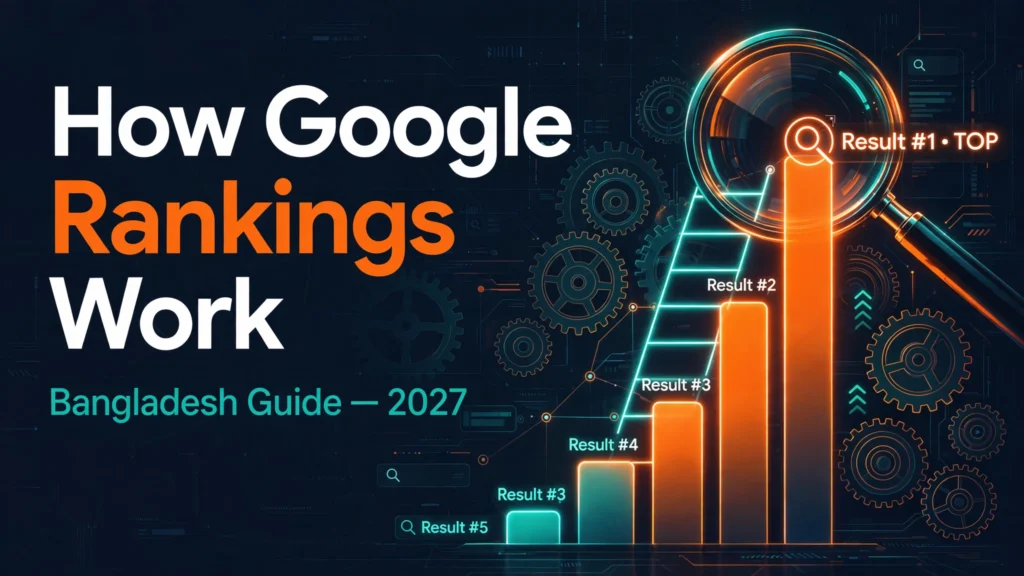
Google ranks pages in three automated stages: crawling (Googlebot discovers your pages), indexing (Google stores and understands them), and ranking (Google orders the best matches for each query). For a business in Bangladesh, ranking comes down to clearing a minimum bar across several categories at once — intent match, content quality and expertise, technical health, authority signals, and user experience. There is no single trick; pages that rank are simply not disqualified anywhere. Google documents this pipeline itself in how Search works.
By 2027 there’s a fourth layer to understand: AI synthesis. Google’s AI Overviews and AI Mode don’t just list pages — they read them, summarize them, and cite sources inside the answer. A page can rank #3 and still lose the click if the AI summary answers the question using a competitor’s content. The mechanics below cover all four layers.
What’s Actually Changed by 2027
The crawl → index → rank pipeline hasn’t changed. What changed is what happens around it:
AI Overviews and AI Mode added a synthesis stage. For a large share of queries, users now see a generated answer before the classic results. Ranking well is necessary but no longer sufficient — your page also has to be legible enough for AI systems to extract and cite: clear definitions, tables, steps, unambiguous factual claims. Nobody controls citations directly, and anyone guaranteeing them is selling fiction.
Scaled thin content became a policy violation, not just weak strategy. Google’s spam policies explicitly target “scaled content abuse” — mass-produced unoriginal pages, including AI-generated content with no added value. The old playbook of publishing hundreds of thin location or keyword pages now risks suppression of the whole site.
Helpful-content signals are baked into core ranking. Content written mainly to rank, with no original value, underperforms systematically — Google’s guidance on helpful content describes exactly what gets rewarded: original, experience-based, complete answers. For Bangladeshi businesses, this is actually good news — most local competitors still publish generic filler, so genuine depth wins faster here than in saturated Western markets.
The local pack and organic results remain separate systems with different rules — relevance, distance, and prominence for Maps; content and authority for organic. Confusing the two is still the most common local SEO mistake I see.
The 6 Ranking Factors That Actually Move Business Sites
Google weighs hundreds of signals, but for a business website they collapse into six factors that decide nearly everything. Each one below follows the same structure: why it matters, how Google evaluates it, how to check your own site, and the misconception that wastes people’s money.
1. Crawlability and Discovery
Why it matters: Googlebot discovers pages by following links. Pages with no internal or external links pointing at them — orphan pages, common after redesigns — simply never get visited. No crawl, no index, no rank.
How Google evaluates it: Crawl frequency and coverage, visible to you in Search Console → Settings → Crawl stats. Large sites get a finite crawl budget; e-commerce stores and news sites with thousands of URLs can waste it on tag pages, filters, and duplicates while money pages wait days for a revisit.
How to check your site: Look at crawl stats for the last 90 days. If Googlebot rarely visits your key pages, or spends most visits on parameter URLs and tag archives, you have a discovery problem — not a content problem.
Costly misconception: “We published 50 new pages, why isn’t traffic up?” — because Google hasn’t found most of them yet. Publishing without internal linking is shouting into a void.
2. Indexation and Rendering
Why it matters: A page that isn’t indexed cannot rank — period. And in 2027, indexing has a second audience: AI systems can only cite pages Google has stored and understood.
How Google evaluates it: Google renders pages like a browser, including JavaScript, then decides what to store. Mobile-first indexing means it judges the mobile version. Pages get excluded for duplicate content, thin content, noindex tags, canonical conflicts, or crawl blocks — Search Console → Pages shows exactly which URLs are excluded and why.
How to check your site: Compare indexed count against your real page count. Read the exclusion reasons literally — “Crawled – currently not indexed” on important pages usually means Google judged the content not worth storing.
Costly misconception: “Our sitemap is submitted, so we’re indexed.” A sitemap is a suggestion, not a guarantee. Google indexes what it considers worth indexing.
3. Search Intent Match
Why it matters: Google’s first job per query is figuring out why someone searched. A query like “dental clinic Dhanmondi” wants a local business, not an essay on dentistry. Pages matching the query’s intent — the right format, the right angle — outrank “better” pages answering the wrong question. Intent mismatch is the single most common reason good content doesn’t rank.
How Google evaluates it: By observing what satisfies searchers at scale — clicks, dwell, refinements — for each query pattern, then favoring the formats that consistently satisfy. This is also why AI Overviews appear on some queries and not others: Google only synthesizes where it can do so reliably.
How to check your site: Search each target keyword incognito and compare what Google shows (product pages, guides, videos, map pack, AI Overview) against your page’s format. Mismatch means rewriting the page’s job, not polishing its prose.
Costly misconception: “Longer content always wins.” A 3,000-word essay cannot outrank a clean product page for a buying query. Length without intent fit is just a longer miss.
4. Content Quality, Experience, and Trust (E-E-A-T)
Why it matters: Google’s systems favor pages demonstrating genuine experience and expertise — content written from real practice, with visible authorship, real details, and no filler. In YMYL-adjacent niches common in Bangladesh (health, finance, legal), this bar is higher.
How Google evaluates it: Through a combination of content signals (originality, depth, first-hand detail), page signals (authorship, about pages, organization schema), and off-page corroboration (mentions, reviews, links from trusted sources). No single “E-E-A-T score” exists — it’s an emergent judgment across signals.
How to check your site: Read your five most important pages as a skeptical stranger. Could anyone have written this, or does it show real practice? Is there a named author with credentials? Real photos, real process details, real customer questions answered?
Costly misconception: “E-E-A-T means adding an author bio.” A bio on generic content changes nothing. Experience has to be in the content, not next to it.
5. Topical Authority
Why it matters: Sites covering a subject in depth — clusters of interlinked pages on related subtopics — consistently outperform sites with a single page on the topic. A clinic with 20 pages on treatments, pricing, and aftercare signals deeper expertise than a competitor with one services page. This is also the mechanism behind AI citations: systems cite sources with demonstrable depth on the specific question.
How Google evaluates it: Through internal linking patterns, coverage breadth, and how often the site’s pages collectively satisfy queries in the topic area. One page per topic is a lottery ticket; a cluster is a strategy.
How to check your site: Pick your three most valuable topics and count genuinely useful, interlinked pages on each. Compare against whoever outranks you. If they have a cluster and you have a page, depth is the gap — not “more backlinks.”
Costly misconception: “We need more blog posts.” Random posts on disconnected topics build nothing. Twenty pages owning one topic beat two hundred scattered ones.
6. Trust Signals: Links, Mentions, Reviews
Why it matters: Links from reputable sites remain a trust signal, weighted toward relevance and quality over raw quantity. Brand mentions, reviews, and citations feed the same trust picture — and for local businesses, they directly drive map-pack rankings.
How Google evaluates it: Link relevance and editorial context matter more than sheer count. A few links from respected, topically relevant sites outweigh hundreds of directory submissions. Meanwhile, Google’s local ranking guidance confirms reviews and prominence drive the map pack as a separate system.
How to check your site: Compare your referring domains against the sites outranking you (Ahrefs and Semrush both offer limited free checks). Also check for toxic residue — I still find BD sites with thousands of spammy directory links from a previous cheap “SEO package” actively suppressing them.
Costly misconception: “500 backlinks for 5,000 taka.” Bulk link schemes violate Google’s spam policies and are one of the few things that still earn manual penalties — months of recovery for a week’s “work.”
Three Separate Systems: Organic, Local Pack, AI Answers
| System | What it ranks | Key signals | What wins |
|---|---|---|---|
| Organic results | Web pages for the query | Intent match, content depth, topical authority, technical health, links | The most complete, trustworthy answer in the right format |
| Local pack / Maps | Businesses near the searcher | Relevance, distance, prominence (reviews, citations) | Complete GBP, review velocity, NAP consistency |
| AI Overviews / AI Mode | Sources to synthesize and cite | Machine-readable structure, factual clarity, entity authority | Clear definitions, tables, schema, original specifics |
The strategic point: most Bangladeshi businesses compete in only one system while ignoring the other two. A clinic with great organic content but an unclaimed Business Profile loses every “near me” search. A site ranking #3 organically but uncitable by AI loses the growing share of queries answered without clicks. Cover all three or accept the leak.
What to Do First: The Priority Order
- Get indexed. Search Console → Pages. Fix exclusions, noindex errors, and crawl blocks first — nothing else matters until Google can see the pages.
- Match intent. For each money page, check what Google actually shows for its target query, then make your page the best version of that format.
- Build topical depth. Turn isolated pages into interlinked clusters around each money topic.
- Fix technical disqualifiers. Speed, mobile usability, HTTPS, architecture — the entry ticket that stops silently disqualifying you.
- Earn trust signals. Reviews, mentions, relevant links, consistent business information across the web.
- Own the local layer. Optimized GBP, accurate citations, local content — a separate system with its own rules.
Notice what’s not on the list: keyword stuffing, buying bulk backlinks, installing “SEO plugins” as strategy, and chasing algorithm rumors. Those are the tactics of 2012, and in 2027 they’re how businesses get penalized.
Common Mistakes Bangladeshi Businesses Make About Rankings
- Optimizing for keywords instead of the systems. Chasing “rank #1” as a single goal while ignoring that the query might be won in the map pack or the AI Overview — different systems, different playbooks.
- Publishing volume to “cover” topics. Fifty thin pages don’t build topical authority; in 2027 they risk scaled-content-abuse suppression. Depth per topic beats page count.
- Treating the Business Profile as optional. For any business with local intent, an unclaimed GBP forfeits the most valuable local real estate on the page to competitors with 200 reviews.
- Measuring rankings by Googling yourself. Personalized, logged-in, wrong-location searches lie. Search Console’s Performance report is the ground truth — use it.
- Judging SEO at week three. Technical fixes move in weeks; content and authority compound over months. Killing a campaign at day 21 because revenue hasn’t moved is the most expensive mistake on this list.
- Ignoring the AI layer entirely. A meaningful share of discovery now happens inside synthesized answers. Content that’s uncitable — vague, unstructured, anonymous — misses the channel completely.
When You’re Ready to Move Forward
Understanding the system is the easy part — the valuable part is knowing exactly where your site stands inside it: what’s blocking crawling, where intent is mismatched, which topical gaps competitors are exploiting, and whether your pages are structured to be cited by AI answers. That’s a diagnostic job, and it’s what I do every week.
Tanveer Evan Rahat is a Dhaka-based AI-driven SEO consultant, and every engagement starts with that diagnostic: a technical and content audit mapping your site against all four layers above — crawl, index, rank, and AI citation. Request a quote and get a clear picture of how Google actually sees your business today. To understand the two halves of the work in more depth, read our technical vs content SEO breakdown, and for the full hiring framework, the complete guide to choosing an SEO expert in Bangladesh.
Frequently Asked Questions
How many ranking factors does Google use?
Google confirms it uses a large number of signals — described as “hundreds” — but publishes no ranked list. Practically, pages need to clear a minimum bar across relevance, quality, technical health, and trust rather than maximizing any single factor. Chasing one “most important” factor is how people waste budgets.
Do backlinks still matter in 2027?
Yes, as one trust signal among many, weighted toward relevance and quality. A few links from respected, topically relevant sites outweigh hundreds of directory links. What changed is that spammy link schemes are now both less effective and explicitly penalized under Google’s spam policies.
Why does my competitor rank higher with worse content?
Usually one of three reasons: stronger domain-level trust (older, more referenced site), better intent matching (their page format fits the query even if the prose is weaker), or technical advantages (faster, better structured, better internal linking). Diagnose before assuming — the answer determines whether you need content work or technical work.
What’s the difference between ranking and being cited in AI Overviews?
Ranking puts your page in the results list; citation puts your content inside the AI-generated answer. Citation requires everything ranking requires, plus machine-readable structure (schema, clear headings, tables) and unambiguous factual claims an AI system can extract confidently. A page can rank without being cited, but rarely gets cited without ranking-worthy quality.
How long before ranking improvements show?
Technical and indexation fixes can move the needle within weeks of recrawling. Content depth and authority typically take 3–6 months to compound. Anyone promising page-one rankings in 30 days is either targeting zero-competition keywords or misleading you.
Should I optimize for AI search instead of Google rankings?
No — optimize for both, because they’re the same foundation. AI systems draw heavily on the signals that drive classic rankings: authority, clear content, structured data, entity clarity. The businesses winning AI citations in 2027 are overwhelmingly the ones that already had strong SEO fundamentals. It’s a layer on top, not a replacement.