Quick Answer
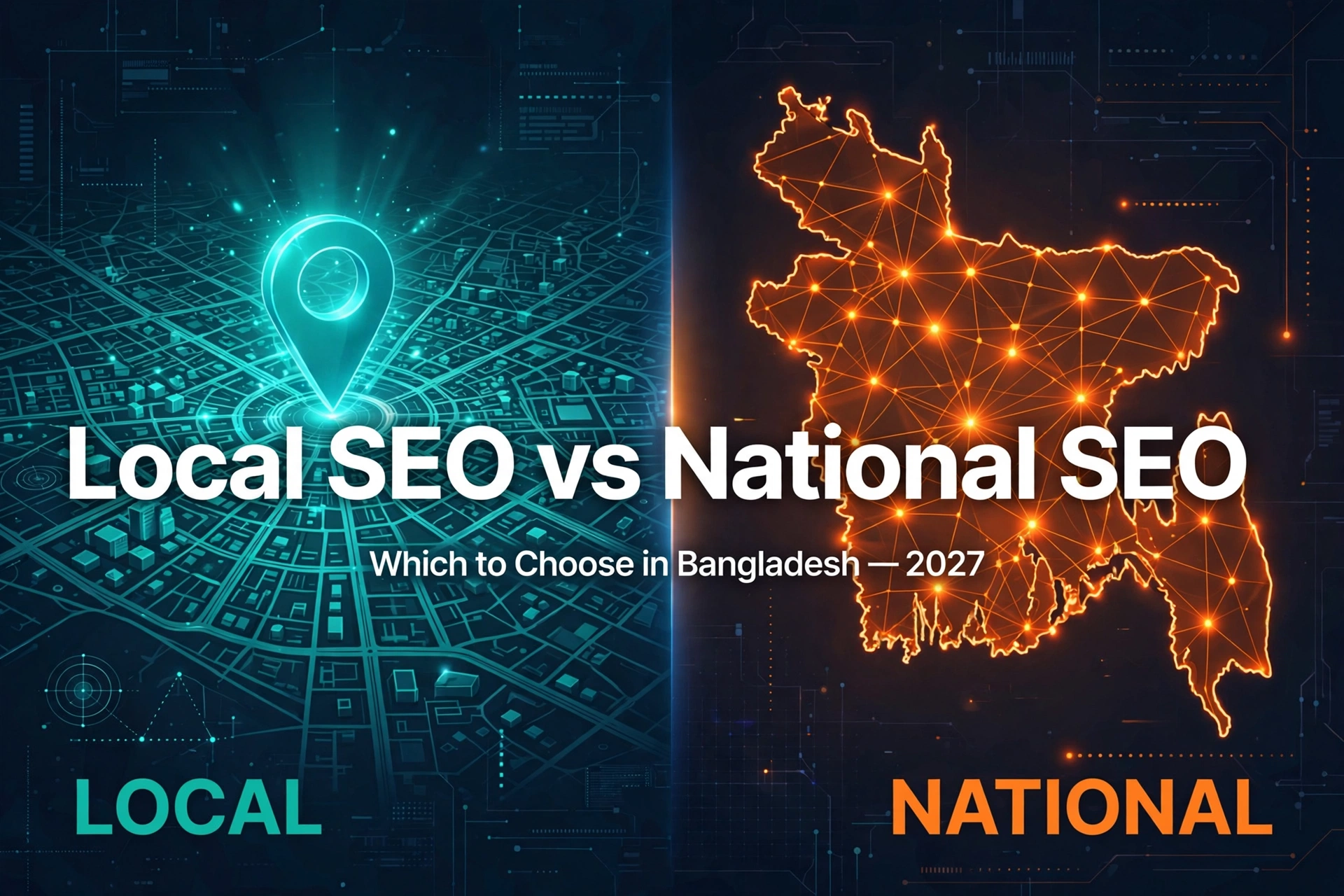
Local SEO gets you found by customers searching near your physical location — the Google Maps pack, “near me” searches, city-specific queries. National SEO gets you found by customers anywhere in the country, regardless of location. A dental clinic in Dhanmondi needs local SEO; an online furniture store shipping nationwide needs national SEO. Many businesses eventually need both — but starting with the wrong one wastes months of budget, because the two compete on different ranking factors, different timelines, and different economics. Answer the six questions below honestly and the right choice is usually obvious.
By 2027, the boundary between the two has blurred in one important way: Google’s AI Overviews increasingly embed local packs and map results inside AI-generated answers. Local visibility now feeds AI citations too — which makes neglecting your Google Business Profile a double loss, not just a Maps problem.
What’s Actually Changed About This Decision by 2027
Three shifts change the local-versus-national calculus now:
AI answers carry local results with them. When a query has local intent, AI Overviews and AI Mode frequently surface map packs and business listings inside the generated answer. The practical effect: GBP optimization — reviews, photos, complete attributes — now influences visibility in two surfaces at once. Businesses that treated local SEO as “just Maps” are underinvesting in work that compounds across both.
Google’s local spam enforcement has teeth. Fake listings, keyword-stuffed business names, and review manipulation draw suspensions faster than they used to — and recovery is slow. Google’s local ranking guidance (relevance, distance, prominence) is the legitimate playbook; shortcuts around it now carry real downside. If a provider offers to “boost” your Maps ranking with tactics they won’t explain, that’s the risk you’re buying.
Bangla and voice queries keep growing. A meaningful share of local searches in Bangladesh happens in Bangla or Bangla-English mix — “ধানমন্ডি ডেন্টাল ক্লিনিক”, “best biryani near me” spoken into a phone. Businesses optimizing only for typed English queries miss this demand entirely. Your GBP business name must stay in its real-world form, but posts, Q&A, and website content can legitimately serve Bangla queries.
The 6-Question Decision Framework
Answer these in order. Each question eliminates one wrong answer more reliably than any generic advice.
1. Where must your customers physically be?
Why it decides: this is the hard constraint nothing else overrides. If customers must visit you (clinic, restaurant, salon, showroom, coaching center) or you serve them at their location within a defined area (plumbers, AC technicians, caterers), local search is where the buying decision happens.
How to answer it honestly: if 80%+ of your revenue requires the customer to be within a specific geography, that’s local — even if you also have a website. If customers can buy from anywhere (e-commerce, SaaS, online courses), that’s national.
2. Do your money keywords trigger a map pack?
Why it decides: Google tells you which game a query belongs to. If searching your main keywords shows a map pack, the query has local intent — and the map pack sits above organic results, capturing the clicks first.
How to answer it honestly: search your 10 most important keywords in an incognito window. Count how many show Maps results. If it’s most of them, you’re buying national SEO for queries where local SEO wins the click — the classic budget waste.
3. What can you afford to sustain for 6–12 months?
Why it decides: national SEO done properly costs more and takes longer — content at national scale plus sustained link building. A thin budget spread across national keywords you can’t win yet buys nothing; the same budget concentrated on dominating your local map pack buys phone calls within weeks.
How to answer it honestly: if the budget only stretches to one front, pick the one where you can win fastest, then expand. Local-to-national is a proven growth path; national-on-a-shoestring is a proven way to burn money.
4. Is your Google Business Profile an asset or a liability right now?
Why it decides: for local-intent businesses, the GBP is the storefront. An unclaimed profile with wrong hours and two reviews means you’re invisible in the most valuable local real estate on the page — while a competitor with 200 reviews takes the calls. No amount of national content fixes this.
How to answer it honestly: search your business on Maps right now. Complete profile, recent photos, review velocity with owner replies? Asset. Unclaimed, outdated, or review-starved? Liability — and fixing it is the highest-ROI work available to you.
5. Are you competing on proximity or on authority?
Why it decides: local rankings weigh proximity — you cannot outrank the shop two streets away with a better website alone. National rankings weigh authority — content depth and backlinks, where anyone can compete. Pick the battlefield where your structural advantages actually apply.
How to answer it honestly: if your advantage is location, reviews, and local reputation, that’s a proximity game — play it. If your advantage is expertise, content, and product range, that’s an authority game. Don’t fight an authority war with proximity weapons or vice versa.
6. Which path reaches revenue first?
Why it decides: SEO is funded by cash flow. Local SEO typically produces visible results in 1–3 months (GBP-driven wins, map-pack movement); national SEO compounds over 4–12 months. The faster path funds the slower one.
How to answer it honestly: map each path to a revenue date, not a ranking date. If local gets you paying customers in month two and national in month eight, the sequencing is obvious: win local, reinvest, then fund national.
Local vs National: The Full Comparison
| Dimension | Local SEO | National SEO |
|---|---|---|
| Primary battleground | Google Maps 3-pack + local organic results (+ AI answers with local packs) | Nationwide organic results |
| Key ranking factors | GBP optimization, reviews, proximity, local citations | Content authority, backlinks, technical SEO |
| Competition | Dozens of nearby businesses | Hundreds of sites nationwide |
| Time to visible results | Often 1–3 months for GBP-driven wins | Typically 4–12 months for competitive terms |
| Typical monthly investment | Lower — bounded scope, fewer pages | Higher — content + links at national scale |
| Main ongoing work | Reviews, posts, photos, citation upkeep | Publishing, outreach, digital PR |
| What “winning” looks like | Calls, direction requests, Maps views | Organic traffic, keyword rankings, revenue |
Business Types: Where to Start
| Business type | Start with | Why |
|---|---|---|
| Clinic, hospital, diagnostic center | Local | Patients choose by proximity; Maps dominates the decision |
| Restaurant, cafe, bakery | Local | “Near me” intent; reviews decide before the menu does |
| Real estate (one city) | Local | Buyers search by area; site visits are local |
| Law chamber, consultancy | Local | Trust + proximity; the local pack converts |
| Home services (AC, plumbing, pest control) | Local | Service-area business; Maps is everything |
| E-commerce (nationwide delivery) | National | Customers anywhere; compete on product SEO |
| Online education / courses | National | Location-independent; content-led growth |
| B2B software / agency services | National | Clients search by problem, not place |
| Multi-branch retail / banks | Both (sequenced) | Brand queries national; branch queries local — win local first |
| Manufacturer / exporter | National | Buyers search by product and capability, not neighborhood |
If you’re weighing who should execute either path, our consultant-vs-agency breakdown covers which engagement model fits which scope — the sequencing question above is one of the most revealing things to discuss with any candidate.
Common Mistakes Bangladeshi Businesses Make Here
- Paying for national SEO when the money is in Maps. The classic waste: a single-location service business on a monthly retainer for “national keyword rankings” while its GBP sits unclaimed. The map pack drives more calls than organic positions 4–10 ever will for local intent.
- Targeting Dhaka when customers are in one neighborhood. “Best salon in Dhaka” is far more competitive than “best salon in Mirpur 10” — and the Mirpur searcher is more likely to visit. Aim too broad, win nothing; aim narrower, win paying customers within weeks.
- One GBP for five locations — or five for one. Each genuine location deserves its own profile; duplicates risk suspension. Google’s Business Profile guidelines are explicit — violating them can remove your listing entirely, which is worse than ranking poorly.
- Ignoring Bangla queries. Optimizing only for typed English misses a large and growing share of local demand. Serve Bangla queries legitimately through posts, Q&A, and content — without touching your real-world business name.
- Trying both fronts on a one-front budget. Splitting a small budget across local and national simultaneously usually means losing slowly on both. Sequence it: win the faster game first.
When You’re Ready to Move Forward
Choosing between local and national SEO isn’t a coin flip — it follows from where your customers are and how they search. Get it right and every taka works harder; get it wrong and you fund months of effort aimed at the wrong battlefield.
I’m Tanveer Evan Rahat, an AI-driven SEO consultant based in Dhaka, and I help Bangladeshi businesses make exactly this call — then execute it. If local is your game, explore my hyper-local SEO services; for the full tactical playbook, read our guide to ranking #1 on Google Maps in Bangladesh. And if you’re not sure which you need, request a free consultation — I’ll tell you honestly, even if the answer is “start with your Google Business Profile yourself.”
Frequently Asked Questions
Can I do local SEO myself?
The basics, yes: claim your profile, complete every field, add real photos, ask customers for reviews, and keep your information consistent online. That alone beats most competitors in Bangladesh. The advanced work — review velocity strategy, local link building, multi-location management, Maps recovery after suspension — is where a specialist earns their fee.
How much does local SEO cost in Bangladesh?
Less than national SEO, because the scope is bounded — typically a smaller monthly investment focused on GBP management, reviews, citations, and location pages. For detailed ranges, see our SEO cost guide for Bangladesh, and request an exact quote based on your locations and competition.
We serve all of Bangladesh but have one office. Local or national?
National — with one local layer. Your office gets a proper GBP and location page (capturing nearby searches), but the main investment goes into national content and authority. Don’t build fake location pages for cities where you have no presence; Google sees through it and customers bounce.
Does local SEO help my regular Google rankings too?
Indirectly, yes. Reviews, local links, and brand searches build overall prominence, which supports organic rankings — and strong content helps local relevance. They’re separate games with shared fundamentals, which is why our complete guide to SEO experts in Bangladesh treats them as one strategy with two fronts.
How long does local SEO take to show results?
GBP-driven wins often appear within 1–3 months — map-pack movement, more calls, more direction requests. Deeper local authority (citations, local links, review velocity compounding) builds over 3–6 months. It’s consistently the fastest-moving SEO discipline, which is why it’s the right starting point for most local businesses.
Should my website target Bangla keywords too?
If your customers search in Bangla — and for local services, many do — yes. Bangla or mixed-language content for FAQs, service descriptions, and GBP posts captures demand that English-only competitors miss. Keep business names in their real-world form; translate the content around them, not the name itself.