Quick Answer
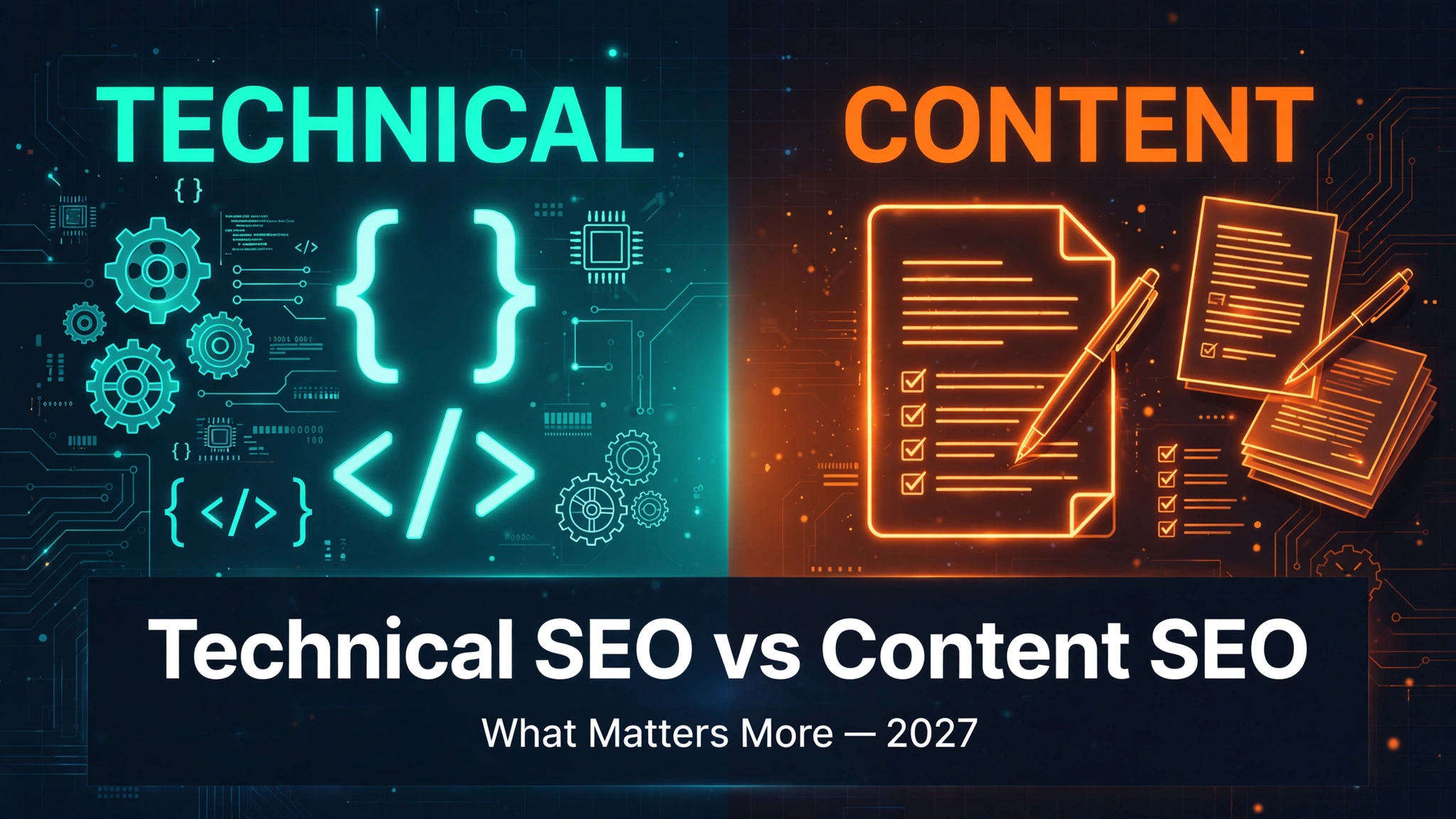
If Google can’t crawl or index your pages properly, you need technical SEO first — no amount of content can rank on pages Google can’t reach. If your pages are indexed but invisible (no impressions, no clicks, stuck on page three or beyond), you need content SEO — your pages exist but don’t deserve to rank yet. The two don’t add; they multiply. Technical SEO determines what percentage of your content’s potential Google can actually see, and content SEO determines how much potential each page has. A zero on either side zeroes the result. Most Bangladeshi business websites I audit need both — but in that order.
By 2027 the stakes on both sides got higher. AI Overviews only cite pages that are both machine-readable (clean structured data, fast rendering — technical) and genuinely quotable (clear definitions, original specifics — content). One half can no longer cover for the other.
What’s Actually Changed by 2027
The old debate — “just publish more content” versus “just fix the site speed” — is obsolete. Four shifts changed what each half has to deliver:
AI answers made structured data a ranking asset, not a nice-to-have. Google’s AI Overviews and AI Mode extract answers from pages they can parse confidently. Schema markup, clean heading structure, and fast server rendering now directly affect whether your content gets cited – that’s technical work with content consequences. Google’s own introduction to structured data is the baseline reference here.
Scaled thin content became a policy risk. Google’s spam policies now explicitly target “scaled content abuse” — large volumes of unoriginal content produced to manipulate rankings, including AI-generated pages with no added value. Publishing 200 thin pages to “cover keywords” isn’t a content strategy anymore; it’s a liability. Content SEO in 2027 means fewer, deeper, genuinely useful pages.
Core Web Vitals got stricter and mobile-only reality set in. Interaction to Next Paint (INP) replaced First Input Delay as the responsiveness metric, and mobile-first indexing is complete — Google evaluates the mobile version, period. For Bangladeshi businesses, where the majority of customers browse on mid-range Android phones over mobile data, a page that loads in 8 seconds on a Dhaka 4G connection loses the customer before Google even finishes judging it.
None of this changed the diagnostic order. Crawl → index → rank is still the pipeline Google documents in how Search works. What’s changed is that each stage now has a 2027 bar to clear. The framework below tells you which bar you’re failing.
The 6-Point Diagnosis Framework
Run these six checks in order. Each one ends in a verdict — technical or content. Stop at the first failure and fix it before spending on anything downstream.
1. Are Your Important Pages Actually Indexed?
Why it matters: A page Google hasn’t indexed cannot rank, appear in AI Overviews, or earn a single click. Indexation is the on/off switch for everything else.
How to check: Open Google Search Console → Pages → compare “indexed” against your real page count. Then run a site:yourdomain.com search on Google. If you have 200 product pages and Google shows 40, you have an indexation problem. Check the exclusion reasons — “Discovered – currently not indexed” and “Crawled – currently not indexed” on money pages are the two that hurt most.
What healthy looks like: Every important page indexed; exclusions limited to genuinely unimportant URLs (tag pages, pagination, internal search results).
Verdict: Key pages excluded → technical SEO first. Do not commission a single new article until this is fixed — new content will leak into the same void.
2. Do Your Pages Pass Core Web Vitals on Mobile?
Why it matters: Google measures real user experience through Largest Contentful Paint (under 2.5 seconds), Interaction to Next Paint (under 200 milliseconds), and Cumulative Layout Shift (under 0.1). Beyond rankings, slow pages bleed conversions — and in Bangladesh’s mobile-data market, the bleed is worse than the ranking effect.
How to check: Run your homepage and two key inner pages through PageSpeed Insights and read the mobile scores, not desktop. Cross-check with Search Console → Core Web Vitals for the site-wide picture.
What healthy looks like: “Good” ratings across LCP, INP, and CLS for the majority of URLs. One weak page is noise; a site-wide red pattern is a verdict.
Verdict: Site-wide failures → technical SEO first. Five new blog posts won’t outrank a competitor whose pages load in two seconds while yours take nine.
3. Did Traffic Drop After a Redesign, Migration, or Platform Change?
Why it matters: Migrations break the invisible infrastructure rankings depend on — redirects, canonicals, internal link equity, URL structures. A traffic drop that coincides with a site change is a technical event until proven otherwise.
How to check: In GA4 or Search Console, pin the exact date traffic fell and match it against launch dates for redesigns, domain changes, HTTPS moves, or CMS switches. Then check Search Console → Pages for a spike in exclusions or 404s in the same window.
What healthy looks like: No coinciding site change, or a change followed by stable indexation and redirect chains resolving correctly.
Verdict: Drop matches a site change → technical SEO first. This is triage, not a content problem — and every week of delay compounds the loss.
4. Are Competitors Outranking You With Deeper, Better-Organized Content?
Why it matters: If the sites above you aren’t technically superior — similar speed, similar age, similar authority — then the gap is what their pages say and how it’s organized. This is the most common content verdict I deliver.
How to check: Open the top three results for your five most important keywords. Compare honestly: do they answer more of the customer’s questions? Do they have pricing, FAQs, comparisons, original photos? Is their content structured with clear headings a reader (and an AI system) can extract answers from?
What healthy looks like: Your pages answer at least as completely as the top three, with original specifics competitors don’t have.
Verdict: Competitors’ pages are deeper and better structured → content SEO first (assuming checks 1–3 passed). Your foundation works; your pages need to deserve their positions.
5. Do Your Pages Match the Search Intent of Their Target Queries?
Why it matters: Most content failures I see aren’t quality failures — they’re intent mismatches. A 3,000-word essay can’t outrank a clean product page for a buying query; a thin product page can’t outrank a proper guide for a learning query. The page answers a question nobody asked.
How to check: Search each target keyword in an incognito window and look at what Google actually shows — product pages, guides, videos, local packs, or AI Overviews. Then look at your page. If the formats don’t match, you have your answer regardless of how “good” the writing is.
What healthy looks like: Your page is the best version of the format Google already rewards for that query.
Verdict: Format mismatch → content SEO first. This is a strategy problem, and no technical fix will solve it.
6. Does Your Site Have Topical Depth, or Just Isolated Pages?
Why it matters: Google increasingly rewards sites that cover a subject completely. A dental clinic with 20 interlinked pages on treatments, costs, aftercare, and FAQs outranks a competitor with a single “dental services” page — even if the competitor’s site is older. One page per topic is a lottery ticket; a cluster is a strategy.
How to check: Pick your three most valuable topics. Count how many genuinely useful, interlinked pages your site has on each. Then count the top competitor’s. If they have a cluster and you have a page, depth is the gap.
What healthy looks like: Each money topic supported by a cluster of interlinked pages covering cost, process, comparisons, FAQs, and location specifics.
Verdict: Isolated pages vs competitor clusters → content SEO first. This is also where AI citations are won — AI systems cite sources with demonstrable topical depth, not single pages.
Technical SEO vs Content SEO: The Comparison
| Dimension | Technical SEO | Content SEO |
|---|---|---|
| What it fixes | Whether Google can find, render, and store your pages | Whether your pages deserve to rank once Google can reach them |
| Typical work | Crawl errors, indexation, Core Web Vitals, schema, canonicals, site architecture, migrations | Intent research, page depth, topical clusters, E-E-A-T signals, internal linking |
| How you know it’s the bottleneck | Search Console exclusions, red vitals, post-migration drops | Indexed but invisible; competitors’ pages are deeper; intent mismatch |
| Time to visible impact | Days to weeks once Google recrawls | Weeks to months — compounds over time |
| Cost profile | Usually project-based or periodic; fixes ship once | Ongoing — publishing, updating, expanding never really finishes |
| 2027 pressure point | Structured data and rendering feed AI citations | Scaled thin content is now a spam-policy risk |
| Red-flag provider | Sells a one-time “technical package” with no monitoring | Sells article volume with no intent mapping or topical plan |
How to Split Your Budget: 4 Common Scenarios
| Scenario | Technical share | Content share | Why |
|---|---|---|---|
| New website | 60–70% | 30–40% | Build the foundation right: architecture, speed, indexation, schema. Content comes on a clean base. |
| Established site, flat traffic | 20–30% | 70–80% | Maintenance-level technical work; the growth lever is deeper content and topical authority. |
| E-commerce (many SKUs) | 50% | 50% | Faceted navigation, crawl budget, and speed are make-or-break; category and buying-guide content drives the revenue. |
| Local business (clinic, restaurant, agency) | 30% | 70% | GBP + reviews + locally relevant content win here; technical needs are usually modest. |
These are starting ratios, not laws. The real split comes from diagnosis — which is exactly what a proper technical SEO audit should establish before anyone quotes you a retainer. Be suspicious of any provider who prescribes the split before examining your site.
Common Mistakes Bangladeshi Businesses Make Here
- Buying content before fixing indexation. Paying for 20 articles while a third of existing pages sit unindexed in Search Console. The new content leaks into the same void.
- Treating technical SEO as a one-time project. “Amader technical SEO kora hoye geche” — then plugin updates, redesigns, and new templates quietly reintroduce debt for two years.
- Hiring a content writer with no SEO brief. Generic articles with no intent mapping, no internal links, and no topical plan. Writing isn’t content SEO; mapped, interlinked, intent-matched writing is.
- Ignoring schema in 2027. Skipping structured data while competitors get cited in AI Overviews built on machine-readable pages. This is the cheapest technical win most BD sites leave on the table.
- Chasing a PageSpeed 100 while pages stay thin. Perfect vitals on a five-page brochure site still rank for nothing. Technical excellence is the entry ticket, not the show.
- Hiring two vendors who blame each other. A “technical guy” and a “content guy” with no shared strategy. SEO is one discipline with two halves — make one party accountable for both, or at least for the diagnosis that sequences them.
When You’re Ready to Move Forward
Run the six checks above before you spend anything — ten minutes in Search Console and PageSpeed Insights will tell you which half deserves your next taka. If you’d rather have the diagnosis done properly, with log-level technical analysis and a content-gap map against your actual competitors, that’s the starting point of every engagement I take on.
Tanveer Evan Rahat is a Dhaka-based AI-driven SEO consultant offering both halves — technical SEO audits and content strategy — always sequenced by diagnosis, never by package. Request a quote and get a prioritized roadmap: technical fixes first where they’re the bottleneck, content investment where that’s the real gap. For the broader hiring picture, our complete guide to choosing an SEO expert in Bangladesh covers how to evaluate any provider against this same standard.
Frequently Asked Questions
Can good content overcome bad technical SEO?
No. If Googlebot can’t crawl or index a page, its content quality is irrelevant to rankings — and invisible to AI Overviews too. Technical SEO is the prerequisite; content quality only influences outcomes for pages Google can actually access.
Can technical SEO alone rank a website?
Only for uncompetitive, navigational queries like your own brand name. For anything with real competition, a technically perfect site with thin content sits on page five indefinitely. The multiplier needs both sides above zero.
How often does technical SEO need attention?
Continuously but lightly. Redesigns, plugin updates, new templates, and migrations all introduce debt. A quarterly technical check plus ongoing Search Console monitoring is enough for most business sites once the foundation is fixed.
Should I hire one person for both halves?
Ideally, yes — or at least one party accountable for the diagnosis that sequences them. Be cautious of anyone selling only content with no technical audit, or only technical fixes with no content plan. The split should follow your site’s data, not the vendor’s product menu.
Does AI search change which half matters more?
It raises the bar on both simultaneously. AI citations require machine-readable pages (schema, clean rendering — technical) and genuinely quotable specifics (definitions, data, original detail — content). If anything, 2027 punishes lopsided investment more than before.
What’s the fastest way to tell which half is my bottleneck?
Search Console → Pages (indexation) and PageSpeed Insights mobile (vitals) take ten minutes. If indexation is broken or vitals are red site-wide, it’s technical. If everything’s indexed and reasonably fast but competitors’ pages are deeper and better organized, it’s content.