Quick Answer
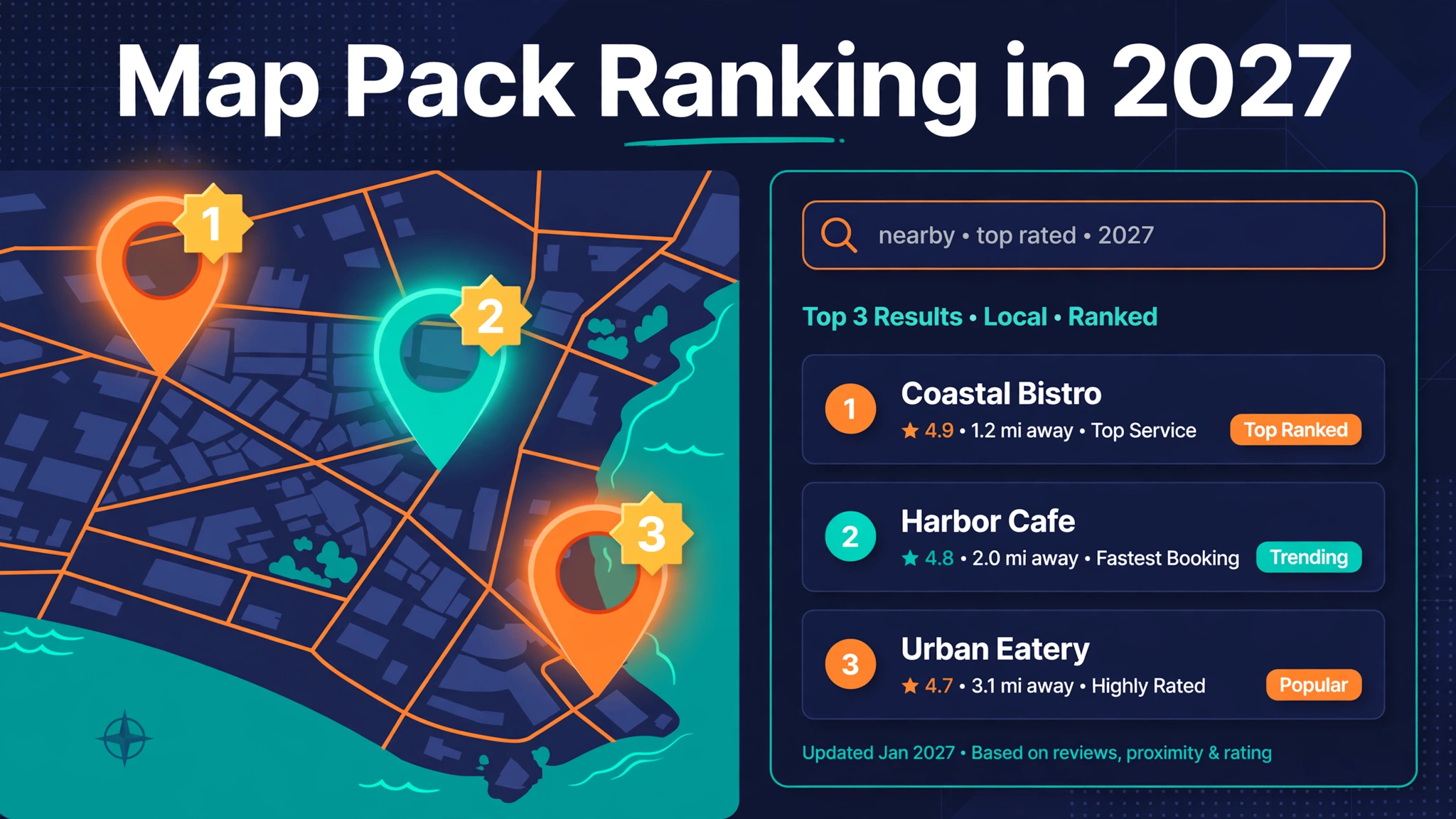
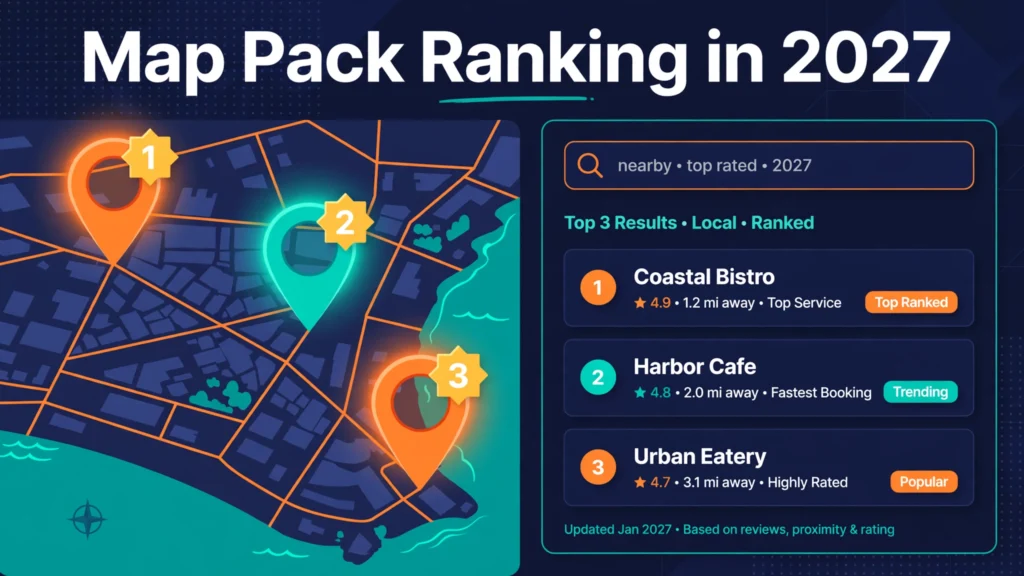
Ranking in the Google Map Pack comes down to three factors Google states publicly: proximity, relevance, and prominence. Proximity is how close you are to the searcher. Relevance is how well your profile and website match what was asked. Prominence is how well-known and trusted your business is, measured through reviews, citations, mentions, and links. You cannot buy proximity and you cannot fake prominence. What you can do, this week, is make relevance unmistakable — the right primary category, every real service listed separately, a complete profile — and build prominence on a system: fresh genuine reviews answered promptly, consistent business facts everywhere, and content that proves you serve the area you claim.
What Has Actually Changed About the Map Pack by 2027
The map pack still shows three businesses, a map, ratings, and quick actions. What surrounds it has changed, and that changes how you should work on it.
AI answers now compete with the map pack for the same query. For a question-style local search — “which driving school near Ilford has evening lessons?” — an AI Overview or AI Mode answer may summarise several businesses before the user reaches the map. The businesses that get summarised are the ones whose facts are consistent and specific enough to quote: real services, real prices, real hours, real reviews. The mechanics are the same ones explained in what local SEO is and how local search works. Map-pack work and AI-answer work are now the same work, not two projects.
Prominence is harder to game and easier to lose. Google removes reviews in waves, including genuine ones, and it has done so repeatedly on profiles managed daily. That is first-hand observation from running a 500-review UK driving-school profile with a daily review-reply system: review generation can never be a one-time campaign, because the total can fall without warning. A business that stops asking for reviews will watch its prominence decay even if it did nothing wrong.
Suspended profiles cost more than slow profiles. The fastest way to leave the map pack entirely is a suspension: a keyword-stuffed business name, an address that does not match a real location, fake reviews, or multiple profiles for one business. Each reinstatement costs weeks of evidence and correspondence. Prevention — one accurate profile, one real name, one consistent address — is cheaper than any recovery.
Google’s own guidance on the three factors is short and worth reading before any tactic: how Google ranks local results. Everything in this post is a working method for those three factors, not a replacement for them.
The Three Factors, and What You Actually Control
| Factor | What you control | What you do not control | First action this week |
|---|---|---|---|
| Proximity | Honest address and service area; location content for areas genuinely served | Where the searcher is standing; where competitors are located | Check the service area matches where you actually travel |
| Relevance | Categories, services, products, description, posts, website pages | How Google interprets a new or ambiguous query | Fix the primary category and list every real service separately |
| Prominence | Reviews, citations, mentions, links, branded searches earned over time | Google’s review-removal waves; competitors’ offline reputation | Start a same-day review request after every satisfied customer |
Most map-pack advice fails because it treats all three factors as equally fixable. They are not. Proximity sets your ceiling. Relevance decides whether you are considered at all. Prominence decides whether you win when several nearby businesses are relevant. Work in that order, and spend the most effort where effort actually moves the result: relevance first, prominence as a system, proximity honestly.
The Five-Lever Map Pack Framework
1. Relevance: categories and services, done properly
Why it matters: Your primary category is the strongest relevance signal on the profile. Google uses it to decide which searches you can appear for at all. A wrong or vague primary category does not just weaken you — it removes you from the searches that matter.
What to check: Is the primary category your actual main service, in the customer’s words? Are secondary categories real services, not aspirational ones? Is every service you sell listed as a separate service, with a description written the way a customer would describe it?
What a strong answer looks like: A driving school lists manual lessons, automatic lessons, intensive courses, refresher lessons, mock tests, and test-day car hire as separate services, because each of those is a separate search with separate intent. A dental clinic lists implants, orthodontics, and emergency appointments separately for the same reason. One generic “services” entry helps nobody.
Red flag: Adding categories for services you do not offer, or stuffing keywords into the business name to fake relevance. Both are policy violations, and competitors can report the name. The full category and service discipline is in the Google Business Profile optimization checklist for 2027.
2. Prominence through reviews: velocity, recency, and replies
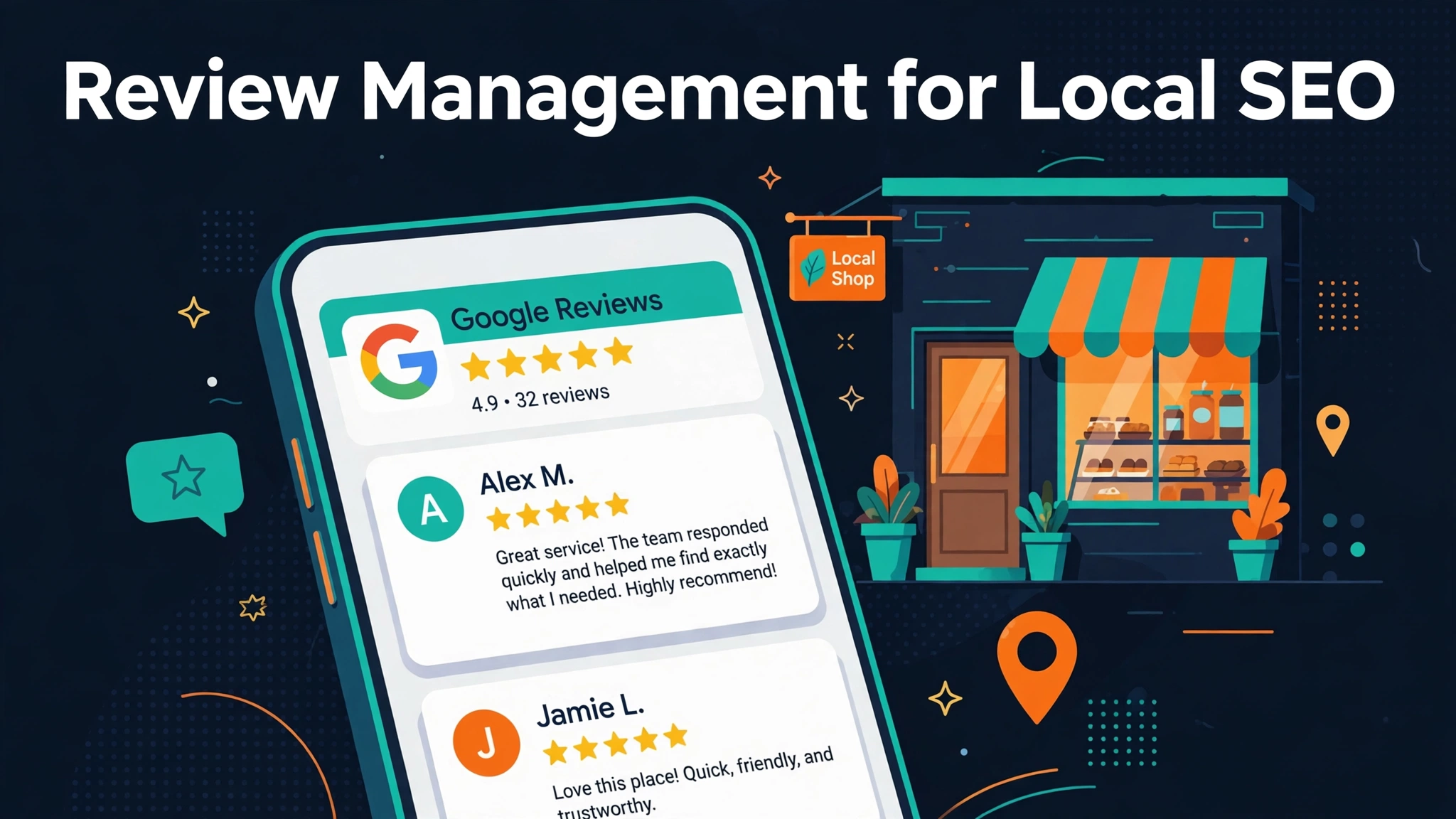
Why it matters: Reviews are the most visible prominence signal, and the only one customers read before they call. Google weighs quantity, recency, velocity, and owner responses together. A profile with 500 reviews frozen two years ago reads as a business that may have changed hands, closed, or stopped caring.
What to check: When was your most recent review? How many arrived in the last 90 days? What proportion has an owner reply, and how fast? Do reviews mention the actual services in natural language — “automatic lessons,” “mock test,” “test-day car hire” — or only “great service”?
What a strong answer looks like: A same-day request after every satisfied customer, with a direct review link, no incentive, no script. Replies to every review within 48 hours: thank the reviewer by first name, reflect the specific service mentioned, and sign as the business team. For a negative review, acknowledge the experience, give a phone number, and take the detail offline. Never argue in public, and never fake a review — this is a hard rule in all local work, because Google removes fakes in waves and a bulk loss looks worse than slow growth.
Red flag: A sudden burst of reviews from one day, reviews that all use the same phrasing, or a review-gating filter that only asks happy customers. All three invite removal, and removal is the one prominence loss you cannot appeal your way out of quickly.
3. Prominence through citations: one entity, everywhere
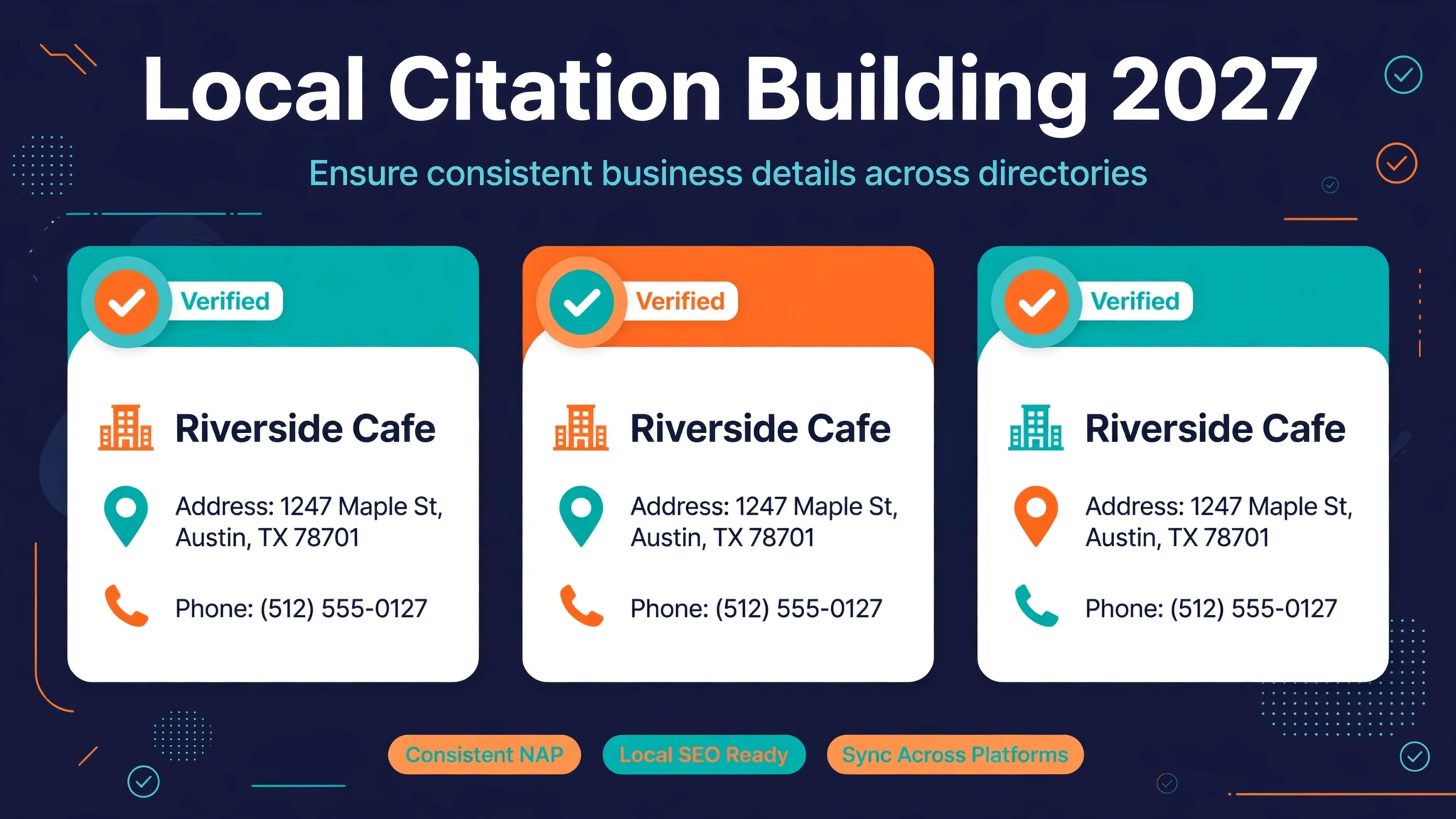
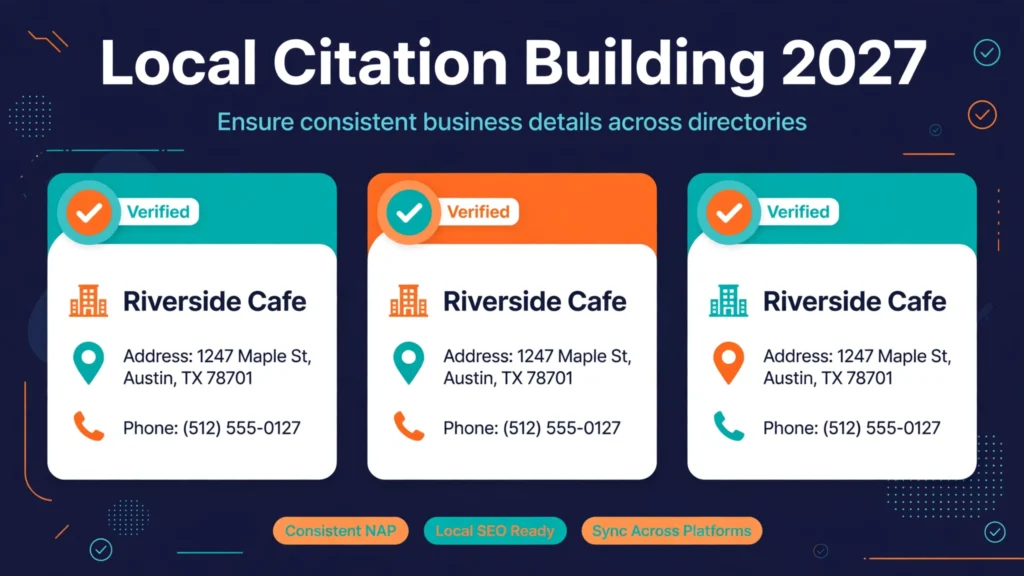
Why it matters: Citations — mentions of your name, address, and phone number on other sites — help Google confirm that your business is real, located where you say, and offering what you say. Inconsistent citations do the opposite: they split one entity into several uncertain ones. One correct address in five trusted places beats five near-correct addresses in fifty places.
What to check: Search your business name plus the old phone number, the old address, and common misspellings. How many listings still carry facts you no longer use? Is the name identical on your website, your profile, and your top directories — not “Ltd” on one, a trading name on another, and a keyword-stuffed version on a third?
What a strong answer looks like: Profile and website fixed first, as the source of truth, then the directories that matter for the niche and the city corrected or claimed, then data aggregators where your market uses them. The full method, including which citation types still move the needle and which are noise, is in the cluster’s local citation building guide for 2027.
Red flag: A bulk submission to hundreds of directories, or a different tracking phone number on each listing. Both fragment the entity Google is trying to understand, and the second also breaks the phone-number consistency that citations exist to prove.
4. Profile activity: posts, photos, and hours that prove you are open
Why it matters: A profile untouched for two years signals a business that may not be there anymore. Fresh posts, real photos, and correct hours do not replace relevance and prominence, but they complete the picture Google shows a searcher at the moment of decision — and they are the cheapest signals to maintain.
What to check: When was the last post? When was the last photo added, and does it show the real premises, team, or work — not a stock image? Are holiday hours set before the holiday, not after a customer arrives to a closed door? Is the description current, in the customer’s words, without keyword stuffing?
What a strong answer looks like: One useful post per week tied to a real question or offer, photos added as the business changes, hours updated the day they change. On the UK driving-school profile referenced in this cluster, the photo gap ran over two years at one point — the fix was a scheduled photo programme, not a one-off upload, because a single upload ages just as fast as the last one did.
Red flag: Posting daily offers with no useful content, or uploading the same image repeatedly. Frequency without substance is noise, and noise trains searchers to ignore the profile.
5. Website proof: pages that match the profile, service by service
Why it matters: The map pack shows the profile, but Google ranks the business. When the website contradicts the profile — different hours, different services, a different phone number — Google has to choose which source to trust, and it may choose neither. When the website proves each claimed service with a real page, relevance deepens beyond what a profile field can carry.
What to check: Does every service listed on the profile have a corresponding page on the website, with the same name, the same price or price context, and the same area served? Does the website carry LocalBusiness structured data with the same facts? Google’s LocalBusiness structured data documentation shows exactly which facts it wants in machine-readable form.
What a strong answer looks like: A service page per real service, a location page per area genuinely served (written for that area, not copied with the city name swapped), and contact details identical to the profile. This is also where AI answers find quotable facts — prices, durations, processes — so specificity on the page is specificity in the answer.
Red flag: Location pages for cities you have never served, created to chase proximity you do not have. They dilute the pages that are true, and they disappoint the customers they attract.
Diagnose Before You Fix: Why You Are Just Outside the Pack
| What you see | Likely cause | Fix first |
|---|---|---|
| Not in the pack, but ranking organically below it | Relevance is there; prominence or proximity is short | Review system + citation audit; check service area honesty |
| In the pack for your street, invisible two miles away | Proximity ceiling, not a penalty | Location content and prominence for the wider area; accept the ceiling where it is real |
| Was in the pack, dropped after no change by you | Review loss, a competitor’s prominence gain, or a profile edit under review | Check review count and pending edits before changing anything |
| Appears for one service, not for another you offer | That service is missing or buried on the profile and website | Add it as a separate service with its own page |
| Profile gone entirely | Suspension or a duplicate profile absorbing it | Stop editing; gather documents and follow the reinstatement route |
The discipline in this table matters more than any single tactic: do not rebuild a profile that is under review, do not add services to chase a drop caused by review loss, and do not “fix” a proximity ceiling with a fake address. Diagnose first, change one thing at a time, and give each change time to be reprocessed before judging it.
Common Mistakes That Quietly Cost Map Pack Positions
- Keyword-stuffing the business name. It can work briefly and cost the profile permanently. Your legal or trading name, exactly as customers know it, is the only safe name.
- One profile, several service areas, no proof. Claiming a radius you never travel to produces bad reviews from the edges, and bad reviews are prominence in reverse.
- Treating reviews as a launch campaign. Fifty reviews in week one and none for six months reads as manipulation followed by silence. Steady beats spectacular.
- Ignoring the reviews you already have. Unanswered negative reviews sit at the top of the profile and answer the customer’s question for you. A calm reply with a phone number costs two minutes.
- Changing categories weekly. Every significant edit can trigger re-verification or a review period. Decide the category structure, set it, and leave it alone unless the business genuinely changes.
- Paying for “guaranteed map pack ranking.” Google guarantees no position to anyone. A guarantee of a specific pack position is a promise the seller cannot keep, and the methods used to chase it are often the ones that get profiles suspended.
A Four-Week Map Pack Sprint
- Week 1 — Audit and diagnose. Record your current pack positions from three search points (at the premises, in the main area served, at the edge of the service area), review count and recency, citation inconsistencies, and any pending profile edits. Use the diagnosis table above, not a generic checklist.
- Week 2 — Fix relevance. Correct the primary category, list every real service separately, align the website pages and structured data with the profile, and set honest hours and service area.
- Week 3 — Start prominence systems. Launch the same-day review request, reply to the entire unreplied backlog at a sustainable pace, and correct the top citation inconsistencies found in week 1.
- Week 4 — Publish and measure. One useful post, one set of real photos, and one service or location page that answers a real customer question. Re-measure from the same three search points and compare like with like — same device type, same search points, same queries.
After the sprint, the work becomes maintenance: weekly posts, daily review replies, monthly citation checks, and a page whenever a new real question keeps arriving. The map pack rewards the business that keeps the system running, not the one that sprints once. The system view — profile, citations, reviews, and geo-content as four disciplines — is what the Local SEO services pillar is built around, and the Bangladesh counterpart to this guide, how Google rankings work for businesses in Bangladesh, works through the same mechanics where far fewer profiles are complete.
When You’re Ready to Move Forward
The map pack is not a trick to learn; it is a reputation to build in public, one accurate fact and one answered review at a time. If you want that system built and run for your business — profile, reviews, citations, and the website pages that prove them — Tanveer Evan Rahat runs local SEO for businesses in Bangladesh and internationally, starting with an audit of where your profile actually stands today: your real proximity ceiling, your relevance gaps, and your prominence compared with the three businesses currently in your pack.
FAQ
How far from my business can I rank in the map pack?
There is no fixed radius. Proximity is relative to the searcher and to competitors, so the practical range depends on the density of your category and the strength of your prominence. A business with exceptional prominence can rank further than a weak competitor next door, but no honest method removes the proximity factor entirely.
How long does map pack work take to show results?
Profile and relevance fixes can change visibility within weeks. Review and citation systems typically need one to three months of steady work to move prominence, and competitive cities take longer. Anyone promising a fixed date for a specific pack position is selling something Google does not guarantee.
Do Google Ads help my organic map pack ranking?
No. Paid ads appear separately from the organic map pack and do not raise your organic pack position. Ads can bring calls while organic prominence builds, but they are not a substitute for it, and they should never be sold as one.
Why did I drop out of the map pack without changing anything?
The usual causes are review loss in a Google removal wave, a competitor gaining prominence, a profile edit sitting in review, or a change in where searchers are searching from. Check review count, pending edits, and positions from the same search points before changing anything — most drops are diagnosed, not guessed.
Can I rank in a neighbouring town where I have no address?
Service-area businesses can rank across the areas they genuinely serve, and prominence and relevance can extend your reach. But proximity still applies, and you will usually rank best near your real base. Ranking in a town with no presence at all, through a virtual address or a copied location page, is not something honest local SEO promises.
Do I need reviews to rank, or is a complete profile enough?
A complete profile can appear, but in any competitive category the pack is decided by prominence, and reviews are its most visible part. A complete profile with no reviews is a business Google can describe but cannot yet trust. The review system is not optional extra work; it is the prominence engine.