Quick Answer
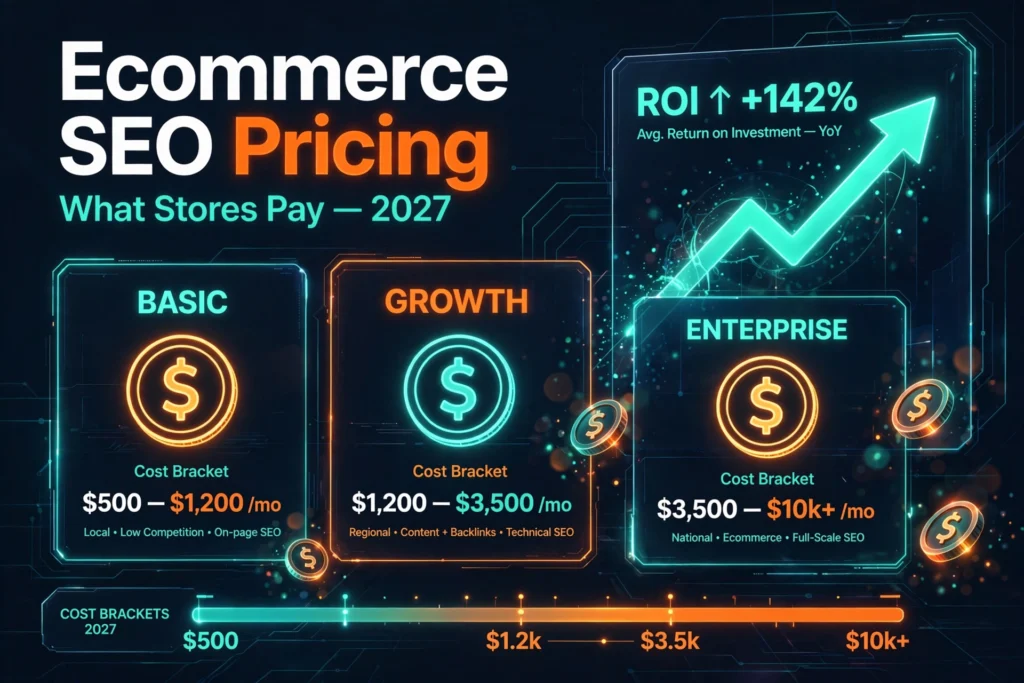
In 2027, international ecommerce SEO typically costs $1,500–$10,000+ per month on retainer, or $5,000–$50,000+ for one-off projects like migrations and technical rebuilds. What you pay is driven by six things: catalog size, platform complexity, content velocity, link-building needs, international scope, and how deep the analytics work goes. A 50-SKU Shopify store and a 50,000-SKU marketplace are not the same engagement — any quote that treats them alike is a red flag.
What’s Actually Changed About Ecommerce SEO Pricing by 2027
Three shifts have repriced ecommerce SEO work in the last two years — and most quotes still floating around online were written before them.
AI surfaces now intermediate the product click. Google’s AI Mode and AI Overviews summarize product options directly on the results page for a large share of shopping queries. Ranking a product page is no longer the whole job — your product data has to be structured so AI can quote it. That means Product schema, review markup, and price/availability structured data are no longer “advanced” line items; they’re baseline. Google’s own Product structured data documentation describes exactly what Google needs to feature your products, and implementing it across thousands of SKUs is real engineering hours.
Crawl budget economics got harsher on big catalogs. Faceted navigation, variant URLs, and parameter chains can multiply a 10,000-SKU catalog into millions of crawlable URLs. Google’s guidance on managing crawl budget for large sites is blunt about the consequences — and fixing faceted-indexation problems is the kind of deep technical work that separates a $1,500/month engagement from a $8,000 one. This is precisely the work behind results like Wood World’s 800% organic growth, where category architecture — not more content — was the lever.
Content velocity became a cost center, not a side task. Manufacturer descriptions duplicated across hundreds of stores stopped working years ago, but in 2027 the bar is original, genuinely useful product copy at scale — plus category copy, buying guides, and comparison content that AI surfaces can cite. Writing 5,000 unique product descriptions is a production operation with a real budget line, and honest quotes reflect that instead of hiding it.
The 6 Pricing Drivers: What You’re Actually Paying For
Every ecommerce SEO quote is some combination of these six cost drivers. When a proposal seems expensive — or suspiciously cheap — check which drivers it covers and which it quietly skips.
1. Catalog Size and SKU Complexity
Why it moves the price: every product page is a page that needs auditing, templating, structured data, and internal-link logic. A 50-SKU boutique can be handled with page-level work; a 20,000-SKU catalog needs template engineering, programmatic fixes, and crawl-budget strategy. The jump from “pages” to “systems” is the single biggest price discontinuity in ecommerce SEO.
Typical range impact: stores under ~200 SKUs generally sit in the lower retainer bands; catalogs above ~5,000 SKUs with variants push engagements into the upper bands because the work becomes architectural.
How to keep it in check: ask whether the proposal prices per-page work or system-level work. If your catalog is large and the quote only mentions “optimizing product pages,” it’s under-scoped — the template layer is where the money is won or lost.
2. Platform and Technical Foundation
Why it moves the price: Shopify, WooCommerce, Magento/Adobe Commerce, and headless builds have completely different SEO cost profiles. Shopify is fast to launch but constrained (URL structure, app bloat, redirect control); WooCommerce is flexible but speed and maintenance are on you; headless and custom builds need developer-grade SEO from day one. Migrations between platforms are their own project category.
Typical range impact: straightforward Shopify/WooCommerce stores trend toward the lower–middle bands; headless, Magento, or multi-platform setups trend upward because every change needs engineering coordination.
How to keep it in check: make the agency name your platform’s specific constraints in the proposal. Generic “technical SEO” line items on a headless build are a sign they haven’t scoped the real work. (Our comparison of Shopify SEO vs WooCommerce SEO in 2027 breaks down where each platform’s costs actually come from.)
3. Content Velocity
Why it moves the price: unique product descriptions, category copy, buying guides, and comparison content — produced every month, at the quality bar Google’s helpful content guidance demands. This is usually the largest variable cost in an engagement, and it’s where cheap providers cut first (AI-spun descriptions at scale are now a direct spam-policy risk, not a shortcut).
Typical range impact: a store needing 20 product descriptions a month and one buying guide is a different engagement from one needing 500 descriptions and a full content hub. Ask for the monthly content output in writing.
How to keep it in check: prioritize ruthlessly — top-revenue categories and products first, long tail later. A good proposal sequences content by revenue impact, not alphabetically.
4. Link Building and Digital PR
Why it moves the price: ecommerce niches are among the most link-competitive on the web. Earning links takes outreach, data studies, product-led PR, and relationship work — months of it. This is also the line item most likely to be faked: cheap “link packages” are the fastest route to a penalty, and cleaning up toxic links costs more than building real ones would have.
Typical range impact: genuine digital PR retainers are commonly the single most expensive component for competitive niches; be suspicious of any quote that promises significant link volume at commodity prices.
How to keep it in check: ask for the method, not the number. “We earn links through data studies and product PR” is an answer; “50 links per month” is a warning.
5. International and Multi-Region Scope
Why it moves the price: every additional market multiplies the work: hreflang architecture, localized keyword research (not just translation), regional link profiles, currency/price structured data, and market-specific competitor sets. A store selling in one country and a store selling in twelve are different businesses from an SEO perspective.
Typical range impact: single-market engagements stay in the standard bands; each additional active market typically adds a meaningful increment — and proposals that price twelve markets like one are under-scoped.
How to keep it in check: sequence markets by revenue, and make sure the proposal distinguishes translation from localization. They’re different costs.
6. Analytics, Reporting, and CRO Integration
Why it moves the price: traffic that doesn’t convert is vanity. Serious engagements wire SEO into revenue analytics — enhanced ecommerce tracking, attribution by category, landing-page CRO testing. This is senior-analyst work, and it’s what turns an SEO retainer from a cost into a P&L line you can defend.
Typical range impact: basic rank-and-traffic reporting is table stakes at every tier; revenue-attributed reporting and CRO programs sit in the upper bands.
How to keep it in check: insist on revenue reporting from month one, even in a simple form. If a proposal only reports rankings, you’re buying the wrong metric.
Typical Ecommerce SEO Pricing by Tier in 2027
The ranges below reflect typical international market pricing for 2027 — what agencies and consultants charge clients in the US, UK, EU, and comparable markets. They are market ranges, not anyone’s rate card: your actual quote depends on the six drivers above, and any provider quoting without scoping them first is guessing. For Bangladesh-market pricing specifically, see our SEO cost guide for Bangladesh, where the economics run lower.
| Store profile | Monthly retainer (USD) | Typical scope |
|---|---|---|
| Startup / small catalog Under ~200 SKUs, single market, Shopify or WooCommerce | $1,500 – $3,500/mo | Technical audit + fixes, template optimization, Product schema rollout, 10–30 product descriptions/mo, foundational links |
| Growing mid-market 200–5,000 SKUs, 1–3 markets, content program running | $3,500 – $7,500/mo | Everything above + category-page program, buying guides, digital PR, faceted-nav cleanup, revenue reporting |
| Enterprise / large catalog 5,000+ SKUs, multi-market, headless or Magento | $7,500 – $15,000+/mo | Dedicated team, crawl-budget engineering, international hreflang architecture, large-scale content production, ongoing digital PR, CRO integration |
One-off projects price differently:
| Project type | Typical range (USD) | When it makes sense |
|---|---|---|
| Platform migration SEO (replatforming) | $8,000 – $40,000+ | Any move between platforms — redirects, URL mapping, traffic-loss prevention |
| Technical rebuild (faceted nav, crawl budget) | $5,000 – $25,000+ | Large catalogs with index bloat or parameter problems |
| Product-schema + structured data rollout | $3,000 – $12,000 | Catalog-wide rich-result eligibility work |
| SEO due diligence (acquisition) | $3,000 – $10,000 | Buying a store and need the real organic picture before you pay |
Retainer vs Project vs In-House: How to Choose
The pricing question most stores get wrong isn’t “how much” — it’s “what shape.” Each model fits a different situation:
| Model | Best for | Watch out for |
|---|---|---|
| Monthly retainer | Ongoing growth: content velocity, link building, technical maintenance — the compounding work | Retainers with no defined monthly output; ask for the deliverable list in writing |
| Fixed project | Bounded problems: migrations, audits, schema rollouts, technical rebuilds | Scope creep; define “done” precisely before signing |
| In-house hire | Large catalogs with constant needs; usually $70k–$120k+/yr salary for a senior ecommerce SEO | One person can’t cover strategy + content + PR + engineering — you’ll still buy specialists |
| Hybrid (consultant + in-house) | Stores with an in-house marketer who needs senior direction | Make sure the consultant’s hours are actually allocated, not “advisory” vapor |
The pattern that works for most growing stores: a fixed project to fix the foundation (technical + templates + schema), then a retainer for the compounding work (content + links). Paying a retainer before the foundation is fixed is like advertising a store with a broken checkout.
Common Mistakes When Buying Ecommerce SEO
- Buying on price per keyword. “Rank 20 keywords for $500” is a 2012 pricing model. Ecommerce SEO wins category and long-tail revenue, not a keyword list — price the outcome (revenue-tracked organic growth), not the input.
- Accepting a quote with no catalog audit. Any proposal priced before someone looked at your SKU count, URL parameters, and template structure is a template quote. The six drivers above exist precisely so you can check this.
- Letting content be an afterthought. The cheapest line item to cut and the most expensive to regret. Manufacturer-duplicate descriptions across 500 products is a known indexation killer — budget for original copy or don’t budget for SEO.
- Ignoring the platform question. An agency that has never done SEO on headless commerce quoting your headless build like it’s WordPress will learn on your money. Ask for platform-specific references.
- No revenue reporting. If month six arrives and the report shows rankings but not revenue, you’ve bought a dashboard, not growth. Revenue attribution should be in the proposal, not added later as an upsell.
- Chasing the lowest bid. In ecommerce SEO, the cheapest quote is usually the one that skips drivers 3 and 4 (content and links) — the two things that actually move revenue. You don’t save money; you buy a slower failure.
When You’re Ready to Move Forward
Pricing guides tell you what the market charges; they can’t tell you what your store needs. That takes someone looking at your catalog, your platform, and your numbers — which is exactly what a proper scoping conversation does. If you’re comparing proposals and want a second opinion on whether the scope matches the price, that’s a conversation worth having before you sign anything.
Tanveer Evan Rahat is an AI-driven SEO consultant who works with online stores internationally — from technical foundation work (crawl budget, faceted navigation, structured data) through the compounding programs (content velocity, digital PR) that turn organic search into a revenue channel. His ecommerce SEO services include the RFL Eshop engagement (1.2M+ organic impressions) and the Wood World category-architecture program behind 800% organic growth. If you run an online store and want your SEO spend tied to revenue instead of rankings, start with a conversation through his quote page — you’ll get an honest read on which of the six drivers actually apply to your store, and what they should cost.
Related reading: our AI SEO pricing guide for 2027 covers the adjacent question of what AI-search optimization costs, and the Bangladesh SEO cost guide covers local-market economics. You can also start from the homepage to see the full range of services.
Frequently Asked Questions
How much does ecommerce SEO cost per month in 2027?
Internationally, typical retainers run $1,500–$10,000+ per month depending on catalog size, platform, content needs, and market scope. Small catalogs on standard platforms sit at the lower end; large multi-market catalogs with heavy content programs sit at the upper end. These are market ranges — your quote should be scoped against the six pricing drivers, not pulled from a table.
Is a $500/month ecommerce SEO package worth it?
Almost never, for a simple arithmetic reason: real ecommerce SEO needs technical work, original content, and link earning, and $500/month buys roughly none of those at professional quality. What it usually buys is automated reports and low-quality links — the latter being an active risk. If $500 is the budget, spend it on a one-time technical audit and fix list instead of a fake retainer.
Should I pay monthly or per project for ecommerce SEO?
Use projects for bounded problems (migrations, audits, schema rollouts) and retainers for compounding work (content, links, ongoing technical maintenance). Most growing stores do both in sequence: project first to fix the foundation, retainer after for growth. Paying a retainer on a broken technical foundation wastes the retainer.
How long before ecommerce SEO pays for itself?
Technical fixes can move revenue-relevant metrics within 1–3 months; content and authority programs typically need 4–9 months to compound. Competitive niches take longer. Anyone promising page-one rankings in 30 days for an ecommerce store is selling you something Google’s spam policies explicitly prohibit.
Why do agencies ask about my SKU count before quoting?
Because catalog size is the biggest cost driver. A 100-SKU store needs page-level work; a 20,000-SKU store needs template engineering and crawl-budget strategy. An agency that quotes without asking is quoting blind — treat that as a red flag, not efficiency.
Does AI search change what I should pay for?
It changes what you pay for more than how much: structured product data, original product content AI can cite, and category pages built as definitive answers are now core scope rather than extras. If a 2027 proposal doesn’t mention AI surfaces or structured data, it’s a 2023 proposal with a new date.
What’s the difference between ecommerce SEO pricing and regular SEO pricing?
Scale and systems. Regular SEO prices pages; ecommerce SEO prices catalogs — template architecture, faceted navigation, variant handling, product schema at scale, and content production in the hundreds or thousands of units. That’s why ecommerce engagements typically start higher and why per-keyword pricing models break down completely here.